
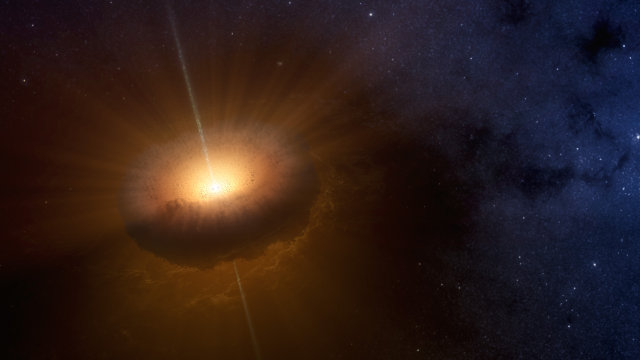
An article published in the journal “Monthly Notices of the Royal Astronomical Society” describes a research of an object called CX330 which for some years has been mysterious and was later found to be a young star. A group of researchers led by Chris Britt of Texas Tech University used data collected from NASA’s Chandra and WISE space telescopes and others to determine its nature. It remains unclear why CX330 is so isolated.
CX330 was discovered in 2009 as an X-ray source during a survey carried out with the Chandra X-ray Observatory on the Milky Way’s central region. Further observations showed that CX330 emitted visible light but that didn’t help to clarify its nature. Chris Britt and his colleagues examined images of the same area captured by the WISE space telescope and they realized that CX330 has plenty of hot dust around it that must have been warmed by outbursts.
A comparison of the data of the WISE mission of 2010 and those collected by the Spitzer Space Telescope in 2007 showed that CX330 is probably a young star that shows the signs of what seem ongoing outbursts. In fact, this phenomenon has been going on for several years, so much that in those three years its brightness increased by some hundreds of times.
The researchers looked for other data collected by ground-based telescopes and in surveys such as ESO’s VVV (VISTA Variables in The Via Lactea) and OGLE-IV, the fourth phase of the Optical Gravitational Lensing Experiment survey. Putting together all the information found on the brightness of CX330 it was possible to better understand its nature and the only possible interpretation is that this it’s a young star that for some reason is in the middle of nowhere.
The CX330 star’s behavior is similar to those of the FU Orionis class, which are not yet in the main sequence and at irregular intervals show significant changes in magnitude and spectral type. However, CX330 is much more compact, hot and probably more massive than any known star of FU Orionis class.
The greatest anomaly of CX330 is given by its isolation. If it were a newborn star like those of FU Orionis class we’d expect it to be close to its “siblings” because stars form in groups from large clouds of gas and dust. The region of that type closest to CX330 is more than a thousand light years away.
The star CX330 looks very young so it must have formed close to its current position. If that’s the case, this is an anomaly. Each new observation seems to bring more questions than answers and exactly for this reason CX330 is an interesting object of study.
