
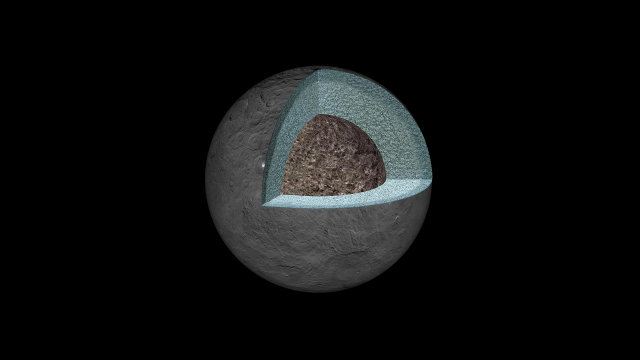
An article published in the journal “Nature” describes a research about the internal structure of the dwarf planet Ceres. A team led by Ryan Park of NASA’s Jet Propulsion Laboratory (JPL) analyzed very precisely the movements of the Dawn space probe, which is orbiting Ceres, to get clues that suggest that it’s composed of a number of layers with the densest in its core and some weak layers that include ice water.
NASA sends and receives radio signals from the Dawn space probe and their analysis allows to measure precisely its speed at all times. This in turn allows the calculation of details of the dwarf planet Ceres’ gravitational field. The analysis of small gravitational variations gave scientists the clues on the dwarf planet’s internal composition.
Altogether Ceres is much less dense than Earth, Moon, other rocky celestial bodies in the solar system but also the giant asteroid Vesta, the largest celestial body of the asteroid belt between Mars and Jupiter after Ceres. According to the researchers, the weak layers separated from the rocky ones when Ceres was still very young while water rose to the outermost layer along with other lightweight materials.
However, this layered structure is less pronounced in Ceres than in the solar system’s planets or the Moon. For example, the Earth has a metallic core, a semi-fluid mantle and an outer crust that make up a defined structure while that of Ceres appears to have a less clear-cut division among its layers. The fact that there’s still a certain division into layers is a confirmation that Ceres is more than an asteroid and it was correct to classify it as a dwarf planet.
The collected information help to better understand the processes that occurred after Ceres’ formation. According to the scientists, water moved in the ancient underground of the dwarf planet. In essence, this is another clue that confirms the theory proposed some time ago that once there was liquid water below the surface.
NASA considered the possibility that the Dawn space probe used the remaining gas in its ion engine to leave Ceres and perform a flyby with asteroid 145 Adeona but eventually decided that Dawn will keep on orbiting Ceres. This way, it can keep on collecting data on this dwarf planet until the end of its mission, which could happen in 2017, to uncover all its secrets.
