
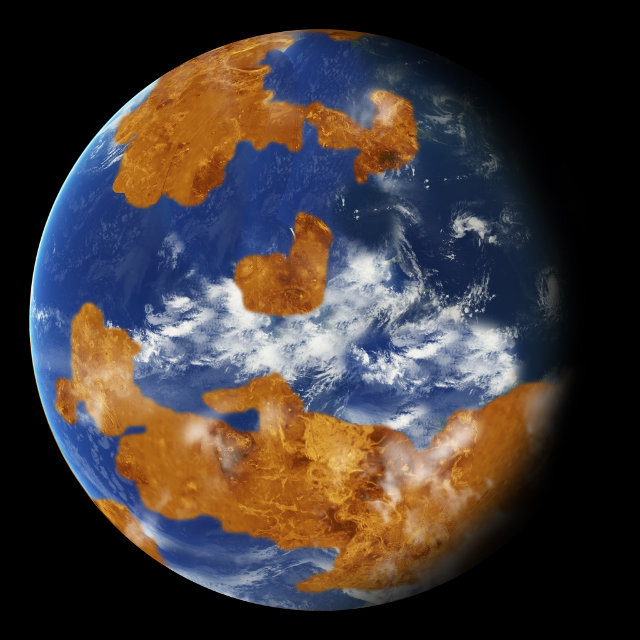
An article published in the journal “Geophysical Research Letters” describes a research in which computer models were used to simulate the possible past climate on the planet Venus. A team of scientists at NASA’s Goddard Institute for Space Studies (GISS) led by Michael Way concluded that perhaps two billion years ago on Venus there was an ocean of liquid water on the surface and the conditions were favorable to life.
A lot of research on the possible presence of life forms, past or present, on Mars have been made in recent years but few concerning Venus. A few decades ago, before the current conditions existing on Venus’ surface were discovered, there was optimism that the planet could host life forms but everything changed after the arrival of space probes that examined it.
Today we know that the surface of Venus is a kind of hell with an atmosphere almost completely formed of carbon dioxide, ninety times thicker than the Earth’s and temperatures that can exceed 460° Celsius (860° Fahrenheit). However, the data already collected by the various NASA Pioneer space probes in the ’80s suggested that Venus had an ocean when it was younger and this theory was revived a few years ago analyzing data collected by ESA’s Venus Express space probe.
According to the analyzes carried out, Venus had once a shallow ocean but perhaps the amount of the land was greater than the Earth. This hypothesis was considered in the simulations and if things were really that way such a characteristic limited the amount of water that evaporated from the ocean and as a consequence the greenhouse effect generated by water vapor so such a condition would’ve been favorable to life.
In this hypothesis they added two more: a day about the same lenght as today’s and a lower amount of solar energy because in ancient times the Sun was dimmer. In the simulations, the Sun emitted 30% less light than today but due to the greater proximity of Venus the planet still received 40% more light than the Earth receives today.
Based on these possibilities, the researchers applied computer models to try to figure out the climate on Venus about two billion years ago and how it evolved. Different versions of the environmental conditions were created by varying slightly the estimates of parameters such as the sunlight received and the day’s length. The results were encouraging.
If the day on Venus was about as long as today – 117 Earth days – the surface warming would’ve generated rain and thick clouds that would’ve created a shield against sunlight. Eventually it’s possible that the average temperature on the surface were even lower than those on Earth.
Such conditions would’ve been favorable to life on Venus but something happened and just over 700 million years ago it radically changed becoming today’s hell. The Venusian geologic activity makes it particularly difficult to find traces of possible ancient life forms. Perhaps we’ll never know with certainty the details of the ancient history of Venus but research still continue.
