
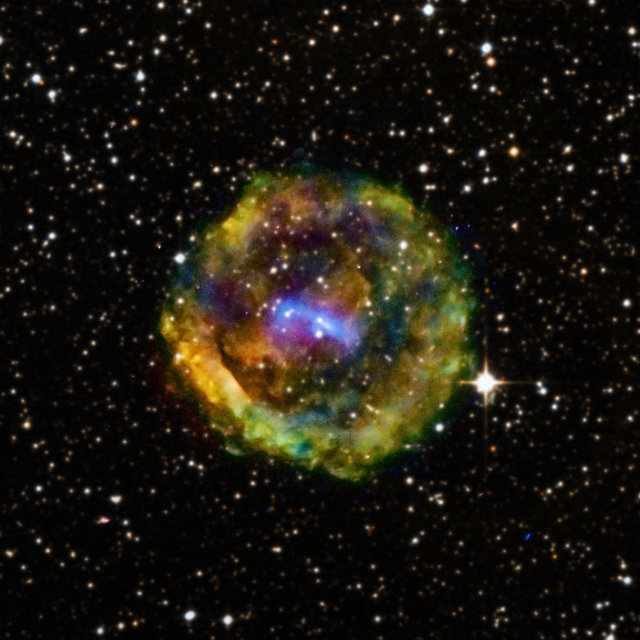
At the workshop “Chandra Science for the Next Decade” being held in Cambridge, Massachusetts, a new image was presented showing a supernova remnant called G11.2-0.3 obtained using NASA’s Chandra X-ray Observatory. For years these were considered the remnants of the supernova recorded by the Chinese in 386 A.D. and for this reason known as SN 386 but new exams indicate that it was a different supernova.
The new data obtained thanks to the Chandra space telescope show that there are dense clouds of gas between G11.2-0.3 and Earth. Previously, infrared observations with the Hale Telescope at the Palomar Observatory had indicated that parts of the supernova remnants were heavily obscured by dust. In essence, the supernova that created those remnants would emit a light that on the Earth would’ve been too dim to be seen with the naked eye in 386 A.D. leaving in the mystery the origin of G11.2-0.3.
The image of G11.2-0.3 presented on this occasion is only the latest in a series captured by the Chandra Space Telescope over the years after it was put into orbit in 1999. The researchers compared the most recent observations with those of 2000, 2003 and 2013 and were able to estimate the supernova remnants’ rate of expansion. As a result, they were able to estimate that from the Earth it would’ve been seen between 1,400 and 2,400 years ago.
Data collected by other observatories had shown that G11.2-0.3 is the product of a supernova caused by the core collapse of a star. That’s not surprising because that’s by far the most common type of supernova, which happens when nuclear fusion generates various elements that get heavier and heavier up to the point where the energy generated determines the explosion. After the supernova a neutron star of pulsar type formed, with an extremely fast rotation, known as PSR J1811-1926.
In the case of the supernova that generated G11.2-0.3, the researchers suggest that the star lost almost all its outer regions, in an asymmetric wind of gas blowing towards outwards or in an interaction with a companion star. They think that the smaller star would have subsequently emitted gas outwards at an even faster rate gathering gas previously lost in the wind and forming a dense shell. At that point, the star would have exploded generating the remnants we see today.
The results of the most recent observations of G11.2-0.3 were already described in an article published in “The Astrophysical Journal” in March 2016. The image presented at the workshop shows low-energy X-rays in red, the medium-energy ones in green and the high-energy ones in blue. Established that the supernova SN 386 didn’t generate G11.2-0.3 the research resumes on two different supernovas.
