
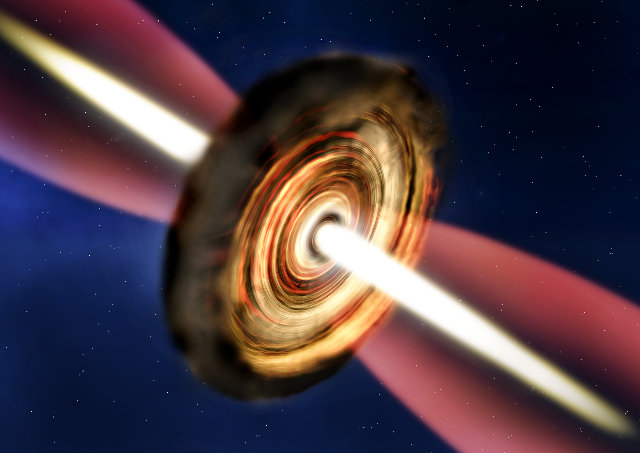
An article published in the journal “Monthly Notices of the Royal Astronomical Society” describes the discovery of a protostar called G11.92-0.61 MM1. A team of astronomers led by John Ilee from the University of Cambridge’s Institute of Astronomy, UK, identified this object in a key stage in the birth of a star. It has a mass that is already more than thirty times that of the Sun and is still attracting materials from the molecular cloud in which it’s forming.
Massive stars, at least eight times the Sun, are difficult to study because they form relatively quickly, in about 100,000 years, and have a short life because they consume hydrogen at very high speeds, making it difficult to find one in the early stages of its life. At about 11,000 light years from the Earth there’s a cloud of gas and dust where conditions are suitable for the formation of new stars, the problem was seeing through it because of its density that obscures optical telescopes.
The team of astronomers used telescopes that can detect electromagnetic emissions with wavelengths far longer than visible light, to be precise the Submillimeter Array (SMA) in Hawaii and the Very Large Array (VLA) in New Mexico. They allowed to uncover G11.92-0.61 MM1 through gas and dust and to understand its characteristics, including the presence of a disc that rotates around it.
This disc is of the Keplerian type, which means it rotates faster at its center than at its outer edges. A similar phenomenon exists in the solar system, where the inner planets rotate around the Sun faster than the outer ones. According to John Ilee that suggests that even such massive stars form in ways similar to the less massive stars such as the Sun.
The Keplerian disc is much more massive than all the planets of the solar system together as its mass was estimated between two and three solar masses. Its mass might be even greater because it might be hidden under layers of gas and dust. According to Dr. Dunga Forgan of the University of St Andrews, lead author of another article on the subject, the disc might be so massive that it will end up falling to pieces due to its own gravity to form other smaller protostars.
For now, there are various estimates and hypotheses regarding certain characteristics of the protostar G11.92-0.61 MM1 and the Keplerian disc around it. The researchers plan to keep on observing that region of space hoping to get more information and to find possible companion stars. To do so they intend to use the ALMA radio telescope, currently the largest in the world and with such sensitivity that it can detect many more details of this exceptional object.
