
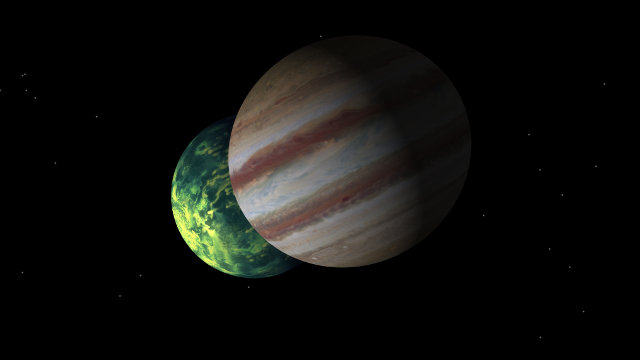
According to an astronomer estimate the Milky Way alone could host one billion gas giant planets like Jupiter. Twenty years of exoplanet discoveries and studies taught us that there are different types of Jovians and their study is important to understand the evolution of a solar system, including our own, given the influence of a planet of that mass. On the other hand, the study of Jupiter also helps our general understand of that class of exoplanets.
David Ciardi is an astronomer of NASA’s Exoplanet Science Institute (NExSci) at Caltech who is studying Jupiter, recently following the mission of the Juno space probe, to understand gas giants. Among these planets there are the hot Jupiters, so called because they orbit very close to their stars and consequently they’re heated up to very high temperatures.
In recent years many hot Jupiters have been found and astronomers are wondering why they are so close to their star. In our solar system gas giants are quite distant from the Sun but it’s possible that Jupiter formed even farther away and then moved closer. One of the topics of study within the history of the solar systems is that of planetary migration, which according to current models takes place at the beginning of their history, when the orbits are not yet completely stable.
Elisa Quintana, a scientist of NASA’s Ames Research Center, explained that the Juno space probe will examine Jupiter to measure for example the water vapor and oxygen on Jupiter within the planet. The analysis of the abundance of these molecules and other elements can help to reconstruct Jupiter’s history providing clues on the area in which it formed and its evolution.
The presence of Jupiter greatly influenced the evolution of the inner solar system during the first phase of its life. It was chaotic era with many collisions and the powerful gravity of a gas giant influenced the trajectories of many objects. Understanding Jupiter’s evolution means understanding better that chaotic history and consequently the early stages of life of the Earth and the Moon.
Surprising results came from simulations of the early stages of the solar system’s history. Scientists thought Jupiter had somehow protected the inner planets attracting asteroids and comets with its powerful gravity. The simulations suggest quite the opposite with celestial bodies passing close to Jupiter with a slingshot effect that accelerates them causing more frequent and more violent impacts on the inner planets, including Earth.
In short, there is still much to understand about Jupiter and the Juno space probe will help us to solve some mysteries about its core and its magnetic field. The information that will be obtained will allow to better understand the role of exo-Jupiters and their influence on the rocky planets in their solar systems.
