
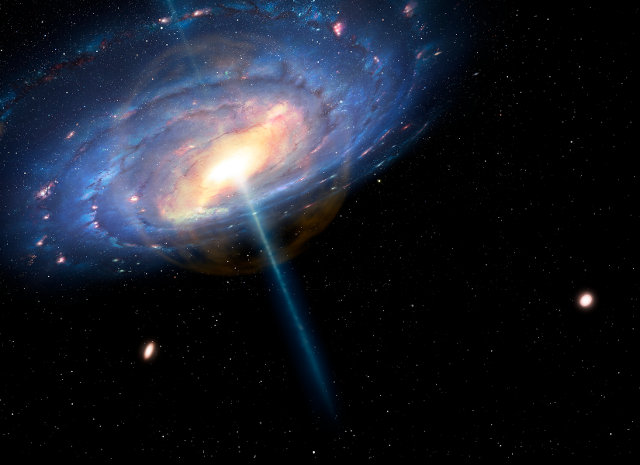
An article published in “The Astrophysical Journal” describes a research about the Milky Way that offers a solution to the problem of the missing mass. A team of scientists led by Fabrizio Nicastro, a research associate at the Harvard-Smithsonian Center for Astrophysics (CfA) and astrophysicist at the Italian National Institute of Astrophysics (INAF), used ESA’s XMM-Newton space telescope to discover a kind of gaseous fog that absorbs emissions from distant sources. The existence of such a bubble indicates that some millions of years ago the Milky Way was a quasar.
The problem of the missing mass is due to the fact that after estimating the mass of the Milky Way things don’t add up. The total mass of the Milky Way is estimated between 1 and 2 trillion solar masses. Over 80% of this mass is composed of dark matter, the remaining composed of baryonic matter – common matter – is between 150 and 300 billion solar masses. The problem is that by adding the masses of visible stars, gas and dust the total mass of the baryonic matter is around 65 billion solar masses.
Fabrizio Nicastro’s team looked in the archive of the X-ray observations made using the XMM-Newton space telescope discovering the existence of a gaseous fog that permeates the Milky Way. This fog forms a bubble that starts from the center of the galaxy extending for about two-thirds of the distance between the center and the Earth. This bubble absorbs the X-rays coming from distant sources preventing their masses from being detected.
This is a really huge bubble and to create a really huge amount of energy was needed. According to the authors of this study the energy was produced by the supermassive black hole at the center of the Milky Way swallowing some of the gas around it to emit other gas at an estimated speed of about 1000 km/s (about 2 millions mph). It’s a type of violent activity observed in quasars but today the Milky Way doesn’t show that kind of activity.
According to calculations, the Milky Way has gone through a quasar period in which the supermassive black hole at its center was very active that lasted between 4 and 8 million years and ended when there wasn’t enough gas to maintain that kind of activity. This phase ended about 6 million years ago and the presence of stars that are that age near the galactic center confirms it because they formed thanks to the materials emitted by the black hole.
The total mass of this bubble is really huge, estimated at about 130 billion solar masses. Putting together all the data, the missing mass of baryonic matter could be found. The estimates were made using simulations therefore will require further tests to be able to say that the mystery has been resolved for good, also with new instruments planned for the coming years.
