August 2016

The molecular cloud behind the Orion Nebula seen by HAWK-I (left) and ALMA (right) (Image ESO/Goicoechea et al.)

An article published in the journal “Nature” describes a research about the molecular cloud located behind the Orion Nebula. A group of researchers used the HAWK-I instrument installed on ESO’s Very Large Telescope (VLT) and the ALMA radio telescope, both ESO’s, to look at key moments of astrochemical phenomena, meaning the chemical reactions that take place in space and in this case in that area and one day will lead to the birth of new stars.

Simulation of the large-scale structure of the universe (Image Nico Hamaus, Universitäts-Sternwarte München, courtesy of The Ohio State University)

An article accepted for publication in the journal “Physical Review Letters” describes a research on the distribution of matter in the universe made in a way different from usual. An international team of researchers studied cosmic voids as if they were photographic negatives from which they could get information about ordinary matter, dark energy and dark matter.

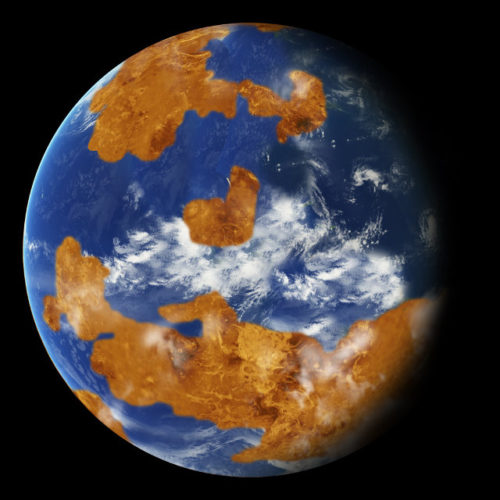
Artistic concept of what Venus possibly looked like 2 billion years ago (Image NASA)

An article published in the journal “Geophysical Research Letters” describes a research in which computer models were used to simulate the possible past climate on the planet Venus. A team of scientists at NASA’s Goddard Institute for Space Studies (GISS) led by Michael Way concluded that perhaps two billion years ago on Venus there was an ocean of liquid water on the surface and the conditions were favorable to life.

The area around dwarf galaxy DDO 68 with a possible satellite seen by LBT (Image courtesy Francesca Annibali/INAF)

An article published in “The Astrophysical Journal Letters” describes a research about the dwarf galaxy DDO 68. An international team of researchers led by Francesca Annibali of the National Institute for Astrophysics (INAF), Italy, used the Large Binocular Telescope (LBT) to make observations that allowed to find evidence that even a very small galaxy can capture smaller galaxies.

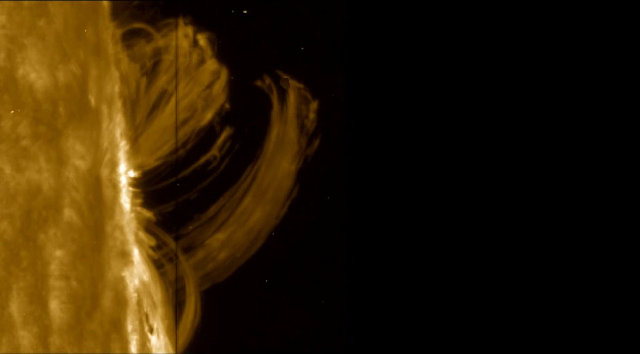
A moment of the July 24, 2016 solar flare (Image NASA's Goddard Space Flight Center; Joy Ng, producer/IRIS/Lockheed Martin Solar and Astrophysics Laboratory)

NASA released the images captured by its IRIS space probe that show a kind of rain that fell on the Sun on July 24, 2016. This event occurred during a mid-level solar flare that led to the ejection of solar material, plasma at very high temperatures which then fell like rain and for this reason is called coronal rain or in more technical jargon post-flare loops.