
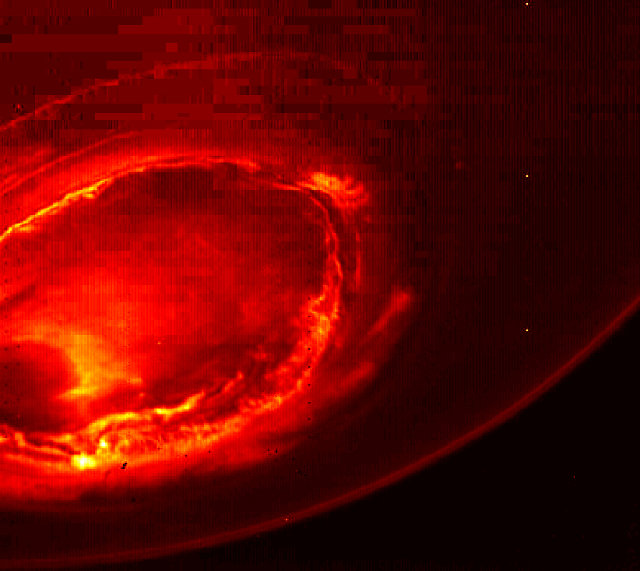
NASA published the first results of the Jupiter flyby the Juno space probe performed on August 27, 2016. In about six hours, Juno reached a distance of 4.200 kilometers (2,500 miles) from the planet and above all passed above both north and south poles. The result is a series of images of the aurora at infrareds with many detail never seen before.
The JIRAM (Infrared Jovian Auroral Mapper) instrument provided by the Italian Space Agency was the great protagonist of this data collection although in this first close approach to Jupiter all the Juno space probe’s scientific instruments were switched on and collected data which required a day and a half to be sent to Earth. The analyzes of the data and images have just started but the results are already interesting.
Alberto Adriani, researcher from Istituto di Astrofisica e Planetologia Spaziali, Rome, Italy, and principal investigator of the JIRAM instrument, explained that it can see beneath Jupiter’s surface. The first images of the planet’s poles collected during the August 27 flyby showed hot and cold areas never seen before. The presence of an aurora at the south pole was expected nonetheless scientists were fascinated seeing it for real for the first time.
This is an important result because it shows that the Juno space probe works as designed with the JIRAM instrument capable of observing Jupiter’s poles and auroras as it was never possible before for any telescope or spacecraft. The southern aurora turned out to be very bright and structured and the details will allow to obtain further information on its morphology and its dynamics.
The data collected by the JIRAM instrument also allowed to create a video showing the two parts that make up its camera: the lower one, in red scale, was used to map Jupiter’s thermal emission at wavelengths of about 4.8 microns while the upper one, in the blue scale, was used to map the auroras at wavelengths of approximately 3.45 microns.
The camera has an exposure time optimized to observe Jupiter’s thermal emission. At the top there is also Io, one of the planet’s largest moons, that is approaching it. The Great Red Spot is visible south of Jupiter’s equator.
The north pole turned out to be interesting as well with the JunoCam camera used for scientific purposes as well as for its major ones, educational and informative. It’s bluer than other parts of Jupiter and there are many storms. Another difference from the rest of the planet is the absence of the typical bands. There are signs that the clouds have shadows and this may indicate that those clouds are at an altitude higher than other planet’s features. Saturn’s north pole has a hexagonal structure, Jupiter’s has not.
The Juno space probe’s Waves (Radio/Plasma Wave Experiment) instrument also provided interesting data recording radio emissions from Jupiter. They have been known since the 1950s but it’s the first time they got detected from such vicinity. The emissions detected by Waves are those specific of energetic particles that generate the great auroras of Jupiter’s north pole, which are the most powerful within the solar system. This will give scientists the chance to understand where the electrons that generate them come from.
It’s a great start for the Juno mission’s science phase. The spacecraft reached the orbit on July 4, 2016 and its instruments work well and scientists obtained the first data on the planet Jupiter to analyze. Over the coming years we can expect news about the largest of the planets of the solar system.
The clip that shows Jupiter seen at infrareds.
