
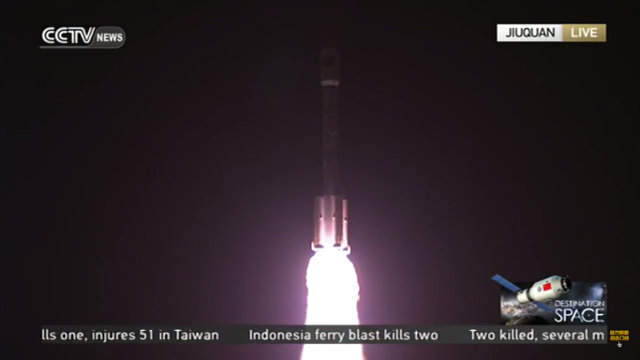
A little while ago the Chinese space laboratory Tiangong-2 (Heavenly Palace 2) was launched from the Jiuquan base atop a Long March 2F T2 rocket. After about 10 minutes it successfully separated from the rocket’s last stage, deployed its solar panels and was place in a temporary orbit. Over the next few days, its thrusters will be used to adjust the orbit to an altitude of about 393 kilometers (238 miles).
The launch of the Tiangong-2 space laboratory represents a step forward for China’s space program, which will culminate in the coming years with the construction of a national space station. It’s the successor of the Tiangong-1 laboratory, which in recent years was used to test various space technologies and for various experiments.
After the end of the Shenzhou 10 mission in June 2013, the Tiangong-1 lab was left in orbit with its on-board instruments switched off, without the possibility to maintain a stable orbit. For this reason, it’s expected that its gradual descent into the atmosphere will cause its disintegration during the next year.
During 2016, China opened to other nations offering the chance to collaborate on scientific experiments to be carried into orbit and in the future to send astronauts to the Chinese space station. For now the new Tiangong-2 laboratory, larger and more advanced than the previous one, will be used to further technological tests and various experiments on a larger scale. It also includes a robotic arm.
The Chinese are providing only some information on their plans. If the Tiangong-2 laboratory works as expected, in the course of October 2016 the resumption of Chinese manned missions is scheduled starting with the Shenzhou-11, which will bring two of them in orbit to dock with Tiangong-2. This mission is scheduled to last a total of 33 days, more than twice the previous record for a Chinese manned mission.
The Tiangong-2 laboratory is scheduled to receive supplies from a cargo spacecraft and the first one, Tianzhou-1, should be launched in the first half of 2017. For the new spacecraft they’ll use the new Chinese rocket Long March 7 and the new Wenchang launch center. In short, China is showing its space program’s ambitions and we have to keep in mind that this is only a part of it.

Permalink
Permalink