
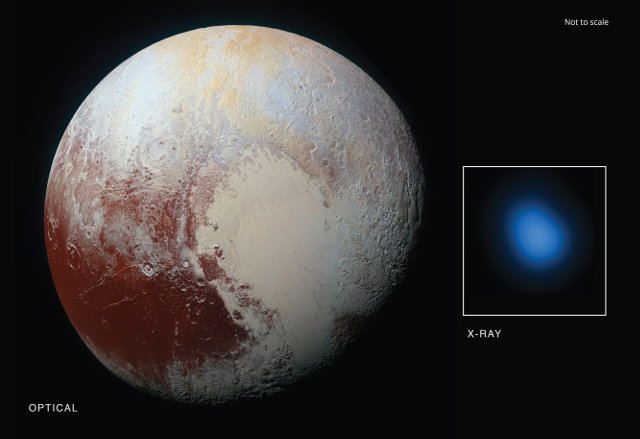
Two new research are connected in different ways to emissions coming from the dwarf planet Pluto. An article published in the journal “Icarus” describes a research which, through the use of the NASA’s Chandra X-ray Observatory, detected X-rays emissions from Pluto. Another article published in the journal “Nature” offers an explanation for the reddish color to Charon’s poles, caused by methane ripped from Pluto’s atmosphere and turned into ice by the low temperatures.
So far, the most distant X-ray emission in the solar system came from Saturn’s rings so few people expected that they could come from Pluto, a dwarf planet that is cold, rocky and devoid of magnetic field. However, in the past Carey Lisse of the Johns Hopkins University Applied Physics Laboratory (APL) detected X-rays from a comet so he knew that the interactions between solar wind and planetary bodies can generate them.
Carey Lisse and his colleagues haven’t only detected X-rays coming from Pluto using the NASA’s Chandra X-ray Observatory but their intensity turned out to be higher than they expected. The team also includes some scientists of NASA New Horizons’s SWAP (Solar Wind Around Pluto) instrument’s team. The space probe performed dwarf planet’s flyby on July 14, 2015 and collected the streams of charged particles from the Sun.
The SWAP instrument uncovered a weak shock wave in the area where the solar wind particles hit Pluto’s atmosphere. The result is an energetic activity more similar to that of the planet Mars than to that of a comet despite the much greater distance from the Sun than the red planet’s. There are various theories to explain the level of X-rays that must be analyzed to try to figure out if one of them is correct.
This discovery could provide the opportunity to examine other celestial bodies in the Kuiper belt to see whether Pluto is unique or there are others that emit X-rays. Meanwhile, the New Horizons space probe is finishing the transmission of the data collected during its flyby and is heading towards another object even farther and the SWAP instrument might find something interesting during its journey.
The discovery that the poles of Charon, the largest moon of Pluto, were of a reddish color, was one of the surprises they had when the first pictures sent by the New Horizons space probe were received. A mission team at the Lowell Observatory led by Will Grundy analyzed images and data received over the last year to try to solve the mystery and offered an answer.
According to the scientists methane escapes from Pluto’s surface as a gas, is captured by Charon’s gravity and ends at this moon’s surface. Ultraviolet light from the Sun turns methane into heavier hydrocarbons and eventually into organic compounds also detected on Pluto known as tholines, which have the reddish color which aroused much surprise.
The tholine theory was already proposed last year but for a confirmation the researchers used data collected by the New Horizons spacecraft and computer models on the evolution of ice at Charon’s poles. Pluto’s year lasts about 248 Earth years, which means that at Charon’s poles there’s light for more than a century and then there’s darkness for over a century. This means that there are extreme weather conditions with temperatures as low as -257° Celsius (-430° Fahrenheit) that make methane freeze.
When the light returns methane sublimates but the heavier hydrocarbons derived from methane remain on Charon’s surface. Sunlight generates enough reactions to turn them into tholines, as happens on Pluto. This process has been going on for millions of years and made Charon’s poles red. In particular, the North Pole area, informally called “Macula Mordor”, is clearly visible in the photographs taken by New Horizons.
Gradually, scientists are understanding what processes take place on Pluto and Charon but surprises seem to never end. Our knowledge of the Kuiper belt is still very limited and the New Horizons mission showed us that even at that distance from the Sun there can be a world in which there’s activity.


Permalink
Permalink