September 2016

The globular cluster Terzan 5 seen by the MAD on the VLT (Image ESO/F. Ferraro)

An article published in “The Astrophysical Journal” describes a research on the globular cluster Terzan 5. An international team of astronomers led by Francesco Ferraro from the University of Bologna discovered that the stars of Terzan 5 are divided into two groups, one with an age of 12 billion years and one with an age of around 4.5 billion years, more or less like the Sun. This unique feature can help to better understand the evolution of the Milky Way.

The OSIRIS-REx space probe blasting off atop an Atlas 5 rocket (Photo NASA/Kim Shiflett)

A few hours ago NASA’s OSIRIS-REx blasted off atop an Atlas 5 411 rocket from Cape Canaveral. After nearly 55 minutes it successfully separated from the rocket’s Centaur last stage, after a few more minutes it deployed its solar panels and started communicating with the mission control center. At that point it started its journey to the asteroid 101955 Bennu to collect a sample and take it back to Earth.

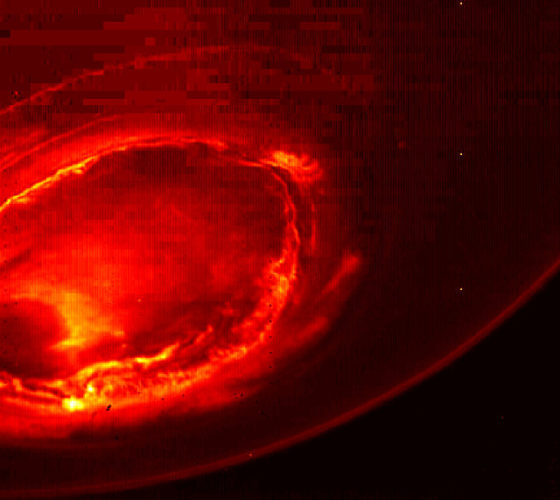
The southern aurora of Jupiter seen at infrareds (Image NASA/JPL-Caltech/SwRI/ASI/INAF/JIRAM)

NASA published the first results of the Jupiter flyby the Juno space probe performed on August 27, 2016. In about six hours, Juno reached a distance of 4.200 kilometers (2,500 miles) from the planet and above all passed above both north and south poles. The result is a series of images of the aurora at infrareds with many detail never seen before.