October 2016

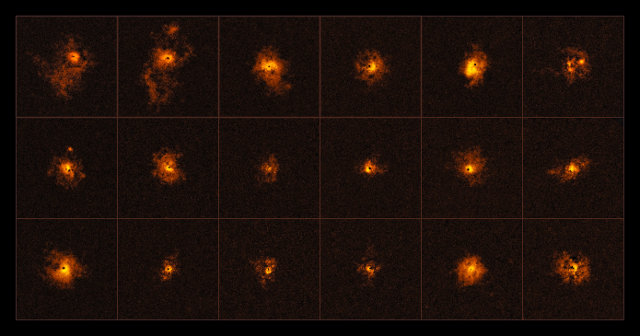
18 of the quasars studied (Image ESO/Borisova et al.)

An article to be published in “The Astrophysical Journal” describes an investigation into the glowing gas clouds around distant quasars. An international team of astronomers led by a group at the ETH (Swiss Federal Institute of Technology) in Zurich, Switzerland, used the MUSE instrument mounted on ESO’s Very Large Telescope (VLT) to look at very distant galaxies that are active, of the type called quasar, and discovered that the gas halos that surround them are more common than expected.

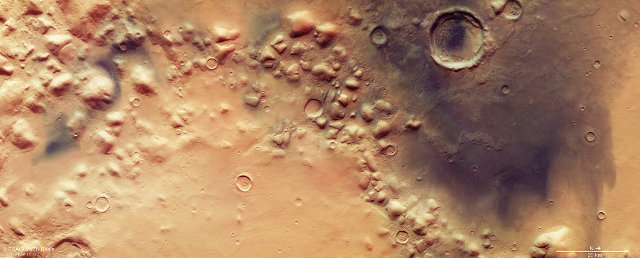
Part of Colles Nili (Photo ESA/DLR/FU Berlin, CC BY-SA 3.0 IGO)

Photos taken by ESA’s Mars Express space probe show the Colles Nili region on planet Mars. It’s very ancient geological feature that mark the boundaries between the northern lowlands and the southern highlands with the remains of ancient glaciers around them. They show signs of glaciations that occurred on Mars during the last few hundred million years.

HI4PI survey map (Image courtesy Benjamin Winkel, Max Planck Institute, and the HI4PI collaboration.)

An article published in the journal “Astronomy & Astrophysics” describes the creation of a map of neutral atomic hydrogen in the Milky Way. An international team of scientists put together data collected by two of the largest steerable radio telescopes in the world, the 100-m Max-Planck radio telescope in Effelsberg, Germany and the 64-m CSIRO radio telescope in Parkes, Australia.