
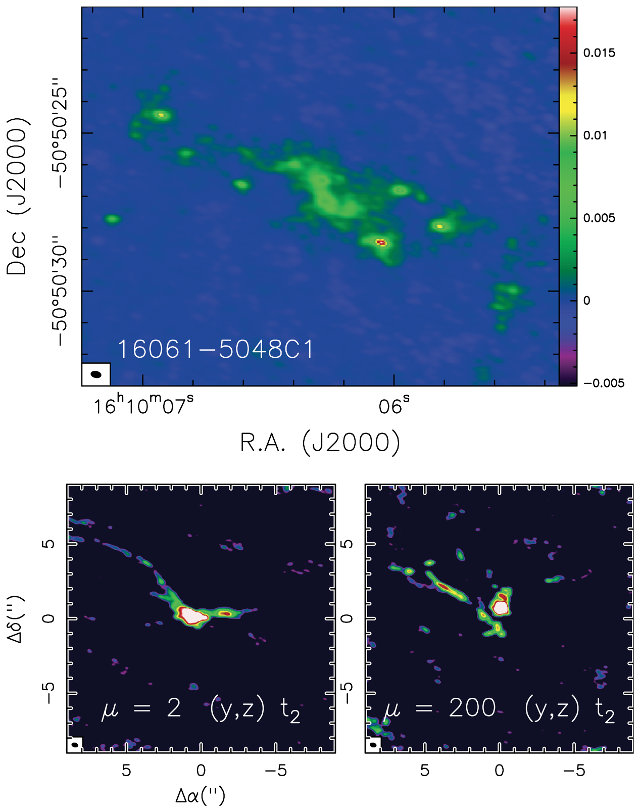
An article published in the journal “Astronomy & Astrophysics” describes a research on a molecular cloud called IRAS 16061-5048C1. A team led by Francesco Fontani from INAF Arcetri Observatory, Italy, used the ALMA radio telescope to observe the fragmentation of clumps of materials distributed along a filamentary-like structure that could form the embryos of future stars and probably of solar systems.
Molecular clouds are interstellar clouds of gas in which hydrogen atoms reached levels of temperature and density that allow the formation of molecular hydrogen, which means molecules consisting of two hydrogen atoms each. They can have total masses that can go from ten to a thousand times that of the Sun. Under certain conditions, they fragment into smaller and dense cclumps which then go on to form new stars with their solar systems.
Only recently, astronomers had access to instruments powerful and sensitive enough to allow them to study molecular clouds so there are still many questions about the mechanisms that cause their fragmentation into clumps. Understanding these mechanisms would allow to understand how stars are born in groups and clusters, where according to cosmological models most stars form.
According to the current theory, the fragmentation into clumps begins when the force of gravity, which tends to crush the molecular cloud on itself, becomes stronger than the turbulence and the magnetic field that instead tend to keep it compact. The amount of clumps, also called population, could be determined by the comparison between turbulence and magnetic field.
If the turbulence is the dominant force within the molecular cloud many small clumps may form with a chaotic distribution. If instead the magnetic field is the most powerful force a few clumps may form that are distributed in a filamentary-like formation.
So far it’s been possible to make just a few observations of molecular clouds and they suggest that the magnetic field is the major force in action. However, the alternative hypothesis is that the many small clumps have masses that may be about one-tenth of the Sun’s and it’s difficult to detect them and to distinguish them with the instruments available to researchers.
The molecular cloud IRAS 16061-5048C1 has an average temperature around 20 Kelvin so it’s really cold. Its total mass is around 300 solar masses and its evolution is at a very early level, making it an excellent candidate to study the fragmentation in its first phase. If there were already newborn stars inside, they would influence the rest of the cloud and the data collected in the study.
The researchers carried out computer simulations to compare the theoretical models with the observations of the molecular cloud IRAS 16061-5048C1. The results indicate that the form, mass and size of the clumps that have formed within the cloud are those generated with the magnetic field as the dominant force.
Putting together the observations made with an extremely powerful and sensitive instrument such as the ALMA radio telescope and sophisticated computer simulations, it was possible to understand the evolution of a molecular cloud. It’s a step forward in understanding the formation of stars and solar systems, in this case seen in its earliest stage.
