
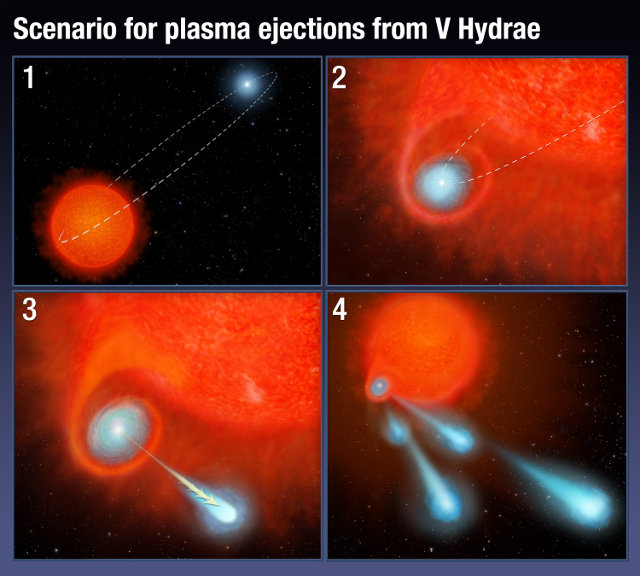
An article published in “The Astrophysical Journal” describes a research on the huge plasma blobs ejected by the red giant star V Hydrae. A team of astronomers led by Raghvendra Sahai of NASA’s JPL used the Hubble Space Telescope to study this phenomenon and concluded that the plasma blobs come from another star, a companion of V Hydrae that we can’t see.
V Hydrae is a carbon star, a red giant with a strong presence of carbon in its atmosphere. Carbon is more abundant than oxygen and the two elements combine to form carbon monoxide. This consumes the oxygen while the remaining carbon combines to form various compounds. The result is a ruby red color.
Since this is a red giant, V Hydrae is in the last stage of its life and has lost more than half its mass ejecting it into space. For this reason, it seemed unlikely that it could also eject gas blobs at very high temperatures twice the size of the planet Mars. To try to understand this phenomenon, V Hydrae and the surrounding region were studied using the Hubble Space Telescope’s STIS spectrograph from 2002 to 2004 and then from 2011 to 2013.
The long period of observations allowed to estimate that the plasma blobs get ejected once every 8.5 years and according to the astronomers this phenomenon has been going on for at least four centuries. The spectroscopic data show that these blobs have temperatures of over 9,400° Celsius (17,000° Fahrenheit) and allowed to track their trajectories up to a distance of about 60 billion kilometers (37 billion miles) from V Hydrae.
According to the researchers, the most likely explanation is that V Hydrae has a smaller companion that we can’t see that has an elliptical orbit that brings it to cross its atmosphere every 8.5 years. This companion steals materials from V Hydrae’s outer layers forming an accretion disk around the smaller star. The consequence is a slingshot effect that leads to these materials’ ejection in the form of plasma blobs at very high speeds.
The explanation offered could also solve the mystery of planetary nebulae and their extraordinary structural diversity. The name was given to them in 1780 by astronomer William Herschel, who thought that they might be planets in formation. Actually, they are incandescent gas shells that are expanding after being ejected during the last phase of life of a star.
The Hubble Space Telescope allowed to discover many planetary nebulae with very different structures but also materials knots nodes. They could be jets ejected from accretion disks formed around other stars, invisible companions just like that of V Hydrae. Many stars form binary systems in which one can be much more massive than its companion with the result that one can reach the end of its life before the other.
It’s unclear how long this phenomenon can go on. Raghvendra Sahai and his team intend to keep on observing V Hydrae, if possible also with the ALMA radio telescope to be able to detect emissions from old blobs that are too cool to emit visible light or other radiation at frequencies detectable by the Hubble Space Telescope.
