
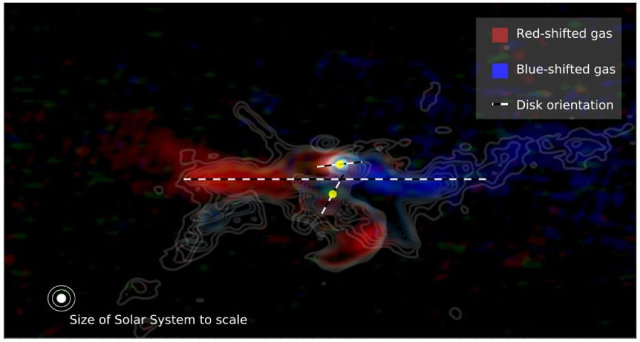
An article published in “Astrophysical Journal Letters” describes a research on the IRS 43 system, which turned out to be really extraordinary because it’s formed by two very young stars each surrounded by a disk of gas but they share a third much bigger disk. A team of scientists from the Niels Bohr Institute, University of Copenhagen, used the ALMA radio telescope to discover this structure never seen before.
Binary systems are very common and the stars that form them can be born in a cloud of gas and dust and remain bound by mutual gravity. These stars can be born together with separate protoplanetary disks that end up forming autonomous planetary systems. What scientists discovered in this case was surprising because it’s the first time that a system is discovered with two stars and three disks.
The IRS 43 system is composed of two stars about 400 light years away from Earth that have an estimated age between 100 and 200.000 years so they’re newborn in astronomical terms. Given their young age, it’s normal that these stars are surrounded by protoplanetary disks in which the formation of new planets might have already begun.
These protoplanetary disks were observed with the telescope ALMA, a very powerful and sensitive instrument inaugurated in March 2013, which allowed to discover that in addition to the two disks belonging to the stars there’s a third one shared between both of them. As if that weren’t surprising enough, the disks are misaligned, on different plans.
The three protoplanetary disks emit electromagnetic radiation at various frequencies because the gas that composes them gets excited by the heat from the two stars. The exam of that radiation allows to understand the direction of the gas relative to Earth by exploiting its frequency changes due to the Doppler effect.
The gas of one of the disks is moving away from us (red-shifted gas in the image). The gas of another disk is instead moving towards us (blue-shifted gas in the image). Through this exam, the scientists realized that the three disks, whose positions are indicated by the dotted lines in the image, move differently and have different inclinations.
Such a system was never seen before so the scientists who discovered it for now can only speculate that it formed in a particularly turbulent manner. The next step in the research will be conducting further observations with the ALMA radio telescope to try to get images at an even higher resolution and other information about thei disks’ composition.
In addition to new observations, the scientists intend to use computer simulations to try to reconstruct the dynamics of the IRS 43 system formation. Putting together all the data, they hope to figure out whether this is an anomaly or a situation that often happens but visible only in the very early stages of a binary system’s life.
