
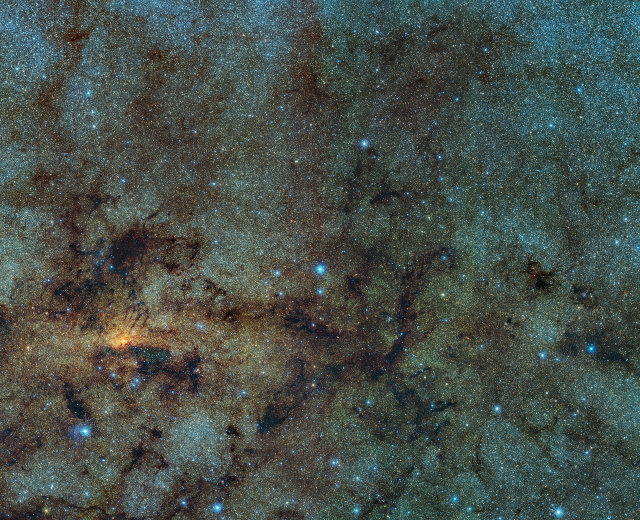
An article published in “The Astrophysical Journal Letters” describes the discovery of the relics of an ancient globular cluster in the Milky Way’s central area. A team of astronomers led by Dante Minniti (Universidad Andrés Bello, Santiago, Chile) and Rodrigo Contreras Ramos (Instituto Milenio de Astrofísica, Santiago, Chile) used observations from the “Variables in the Via Lactea with VISTA” (VVV) survey carried out with ESO’s VISTA telescope to discover the ancient stars of type RR Lyrae for the first time in that area.
RR Lyrae stars are variable type stars so their brightness changes over time and since those fluctuations are regular they provide sufficient information to astronomers to calculate their distances. However, they’re often outshined by young and very bright stars while in other cases their brightness is hidden by dust. The VVV survey was conducted at infrareds giving hopes to identify variable stars of that type but their research was still difficult.
In the end, astronomers discovered a dozen RR Lyrae stars in the Milky Way’s central area. It’s not just an astronomical curiosity but an important discovery because their presence may help to better understand the formation of galactic nuclei. In particular, we’re talking about the formation of the bulge, the vast central formation consisting of a large number of stars typical of spiral galaxies.
There are two theories that try to explain the formation of the bulge: according to one of them it happens through the merger of globular clusters while according to the other one it happens through the rapid accretion of gas. RR Lyrae stars are almost always present in globular clusters therefore their discovery is a strong indication that the bulge in the Milky Way’s nucleus formed through mergers.
The RR Lyrae stars discoved are probably more than 10 billion years old, which means that they’re now dim survivors of what was perhaps the oldest and most massive star cluster in the Milky Way. This research also offers an explanation to the formation of the bulge of other galaxies, which could have occurred through the same mechanism.
