
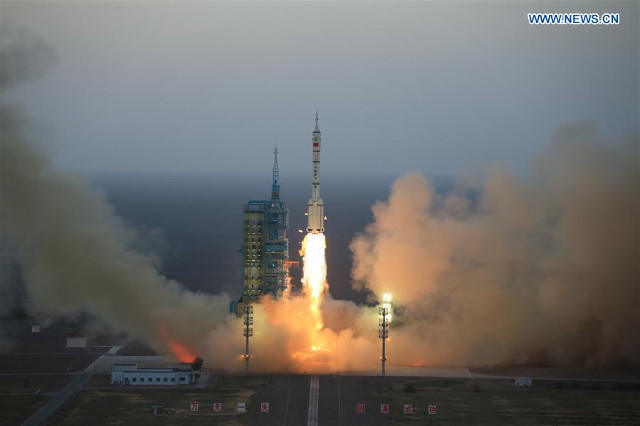
In China it was morning when the Chinese spacecraft Shenzhou 11 was successfully launched atop a Long March 2F rocket from the Jiuquan Satellite Launch Center. After nearly nine minutes it separated from the rocket’s second stage and regularly entered into low-Earth orbit to begin its mission scheduled to last 33 days.
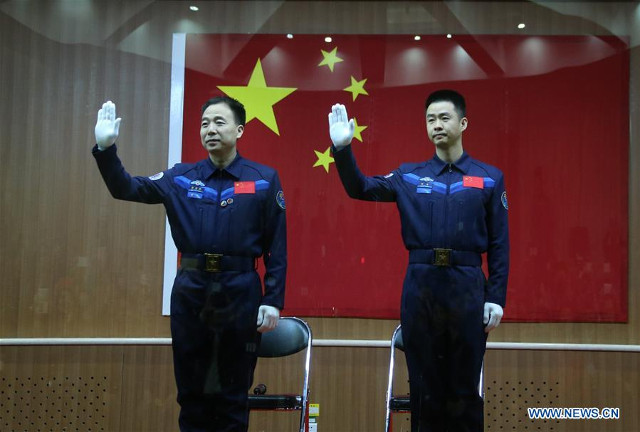
The news about this mission are limited, so much that only during the weekend the two astronauts – or taikonauts as they are called in China – participating in the mission were introduced to the public. The Commander is Jing Haipeng, who will turn 50 years in space, the first Chinese astronaut on his third space mission as he already participated in the Shenzhou 7 mission and already commanded the Shenzhou 9 mission.
The other crew member is Chen Dong, 37, a Chinese Air Force pilot on his first trip into space. He was selected as an astronaut in 2010 in a class of seven people. During the critical moments of the Shenzhou 11 mission he will assist his commander and will work with him in the tasks to be carried out in space.
Tomorrow, the Shenzhou 11 spacecraft is scheduled to reach the Tiangong 2 space laboratory, launched into orbit at about 393 kilometers above sea level a few weeks ago, with an automatic docking maneuver. There, the two astronauts will start a series of experiments and technological tests that will go on for approximately 30 days.
In the previous Chinese manned missions, the crews were typically made up of three astronauts. This time the crew consists of only two people because the life support systems of the Tiangong 2 space lab are not enough to support more astronauts for such a long period. This mission will also serve to test life support systems in medium-duration missions.
Due to the length of the mission, the two astronauts will undergo various medical tests to check their reactions spending a month in a state of microgravity. The Shenzhou 11 mission will be much longer than the previous Chinese missions so for Chinese researchers this will be an opportunity to gather a lot of new data.
For China the Shenzhou 11 mission is an important step towards the start of its own space station’s construction. Sending astronauts in space also serves to prepare them for other types of missions because the Chinese also plan to send them to the Moon during the next decade.

Permalink