October 2016

The central part of the Milky Way (Image ESO/VVV Survey/D. Minniti)

An article published in “The Astrophysical Journal Letters” describes the discovery of the relics of an ancient globular cluster in the Milky Way’s central area. A team of astronomers led by Dante Minniti (Universidad AndrĂ©s Bello, Santiago, Chile) and Rodrigo Contreras Ramos (Instituto Milenio de AstrofĂ­sica, Santiago, Chile) used observations from the “Variables in the Via Lactea with VISTA” (VVV) survey carried out with ESO’s VISTA telescope to discover the ancient stars of type RR Lyrae for the first time in that area.

2014 UZ224 orbit (Image JPL Horizons / Sky and Telescope)

David Gerdes, a professor of astrophysics at the University of Michigan, and a number of colleagues associated with the DES (Dark Energy Survey) survey have discovered a new dwarf planet that currently has a distance of about 14 billion kilometers (about 8.5 billion miles) from the Sun. Called for now just 2014 UZ224, it’s among the most distant celestial bodies discovered in the solar system after the dwarf planet Eris and the possible dwarf planet known as V774104 whose discovery was announced in December 2015.

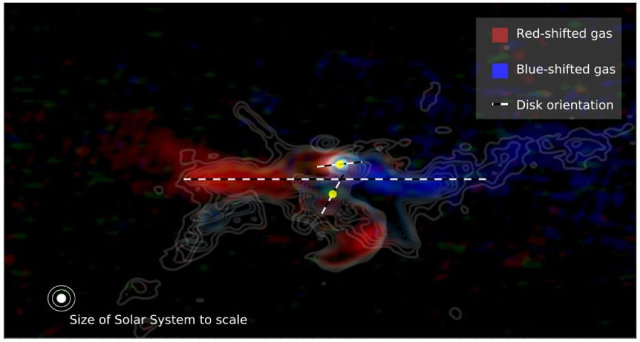
The IRS 43 system (Image courtesy Christian Brinch/NBI/KU)

An article published in “Astrophysical Journal Letters” describes a research on the IRS 43 system, which turned out to be really extraordinary because it’s formed by two very young stars each surrounded by a disk of gas but they share a third much bigger disk. A team of scientists from the Niels Bohr Institute, University of Copenhagen, used the ALMA radio telescope to discover this structure never seen before.

Wharton Ridge (ImageNASA/JPL-Caltech/Cornell/Arizona State Univ.)

After extending the mission of the venerable Mars Rover Opportunity another time, NASA announced that it will drive down a gully dug by a fluid a long time ago, maybe by water. The goal is to understand whether this is the remains of an ancient Martian river. It’s the beginning of yet another mission for Opportunity, which suffers wear and might be at risk because of a storm that will hit Mars.

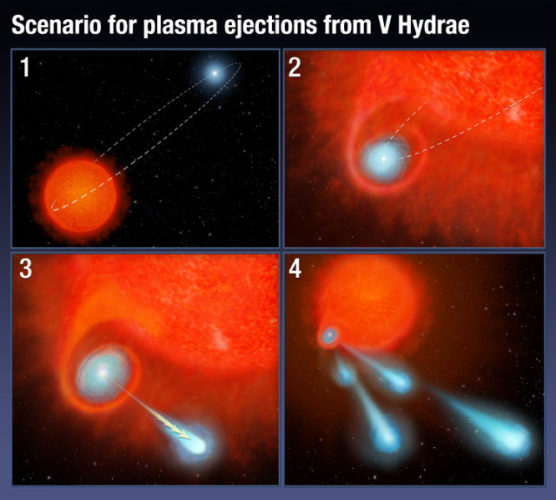
Sequence of interactions between V Hydrae and its companion that cause the ejection of plasma blobs (Image NASA, ESA, and A. Feild (STScI))

An article published in “The Astrophysical Journal” describes a research on the huge plasma blobs ejected by the red giant star V Hydrae. A team of astronomers led by Raghvendra Sahai of NASA’s JPL used the Hubble Space Telescope to study this phenomenon and concluded that the plasma blobs come from another star, a companion of V Hydrae that we can’t see.