October 2016

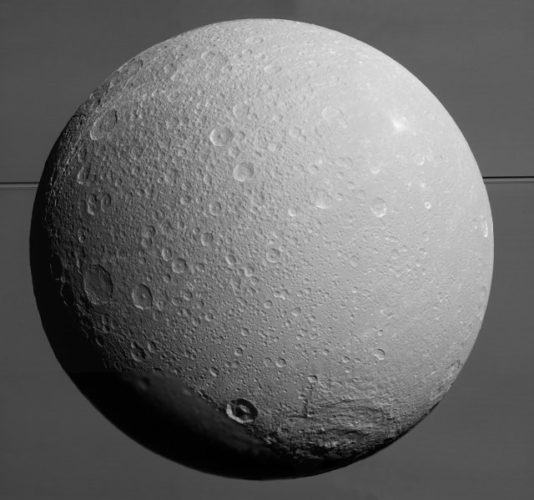
Dione (Image NASA/JPL-Caltech/Space Science Institute)

An article published in the journal “Geophysical Research Letters” describes a research on Dione and Enceladus, two of the planet Saturn’s moons. Using data collected by the Cassini space probe, Mikael Beuthe, Attilio Rivoldini and Antony Trinh of the Royal Observatory of Belgium in Brussels calculated in a new way the two moons’ icy crust thickness concluding that Dione has an underground ocean as well.

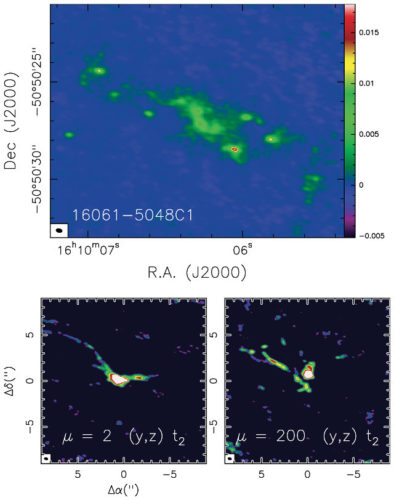
The molecular cloud IRAS 16061-5048C1 and in the lower panels images from computer simulations (Image courtesy Francesco Fontani/INAF)

An article published in the journal “Astronomy & Astrophysics” describes a research on a molecular cloud called IRAS 16061-5048C1. A team led by Francesco Fontani from INAF Arcetri Observatory, Italy, used the ALMA radio telescope to observe the fragmentation of clumps of materials distributed along a filamentary-like structure that could form the embryos of future stars and probably of solar systems.

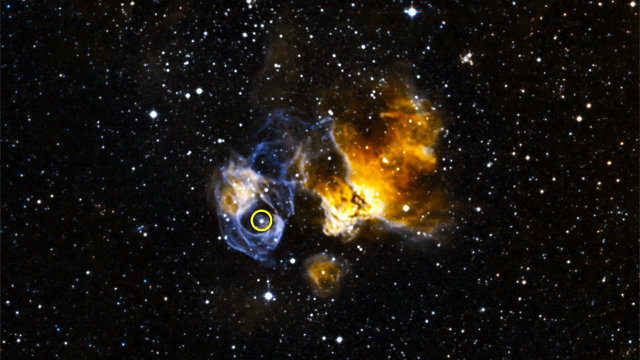
The supernova remnant DEM L241 with the gamma-ray binary LMC P3 in the circle (Image X-ray: NASA/CXC/SAO/F. Seward et al; Optical: NOAO/CTIO/MCELS, DSS)

An article published in “The Astrophyisical Journal” describes the discovery of the first gamma-ray binary found outside the Milky Way, called LMC P3. A team of researchers led by Robin Corbet at NASA’s Goddard Space Flight Center used the Fermi space telescope to discover this couple in the Large Magellanic Cloud formed by a giant blue star and a companion that might be a neutron star or a black hole that are interacting producing cyclic gamma-ray emission.