
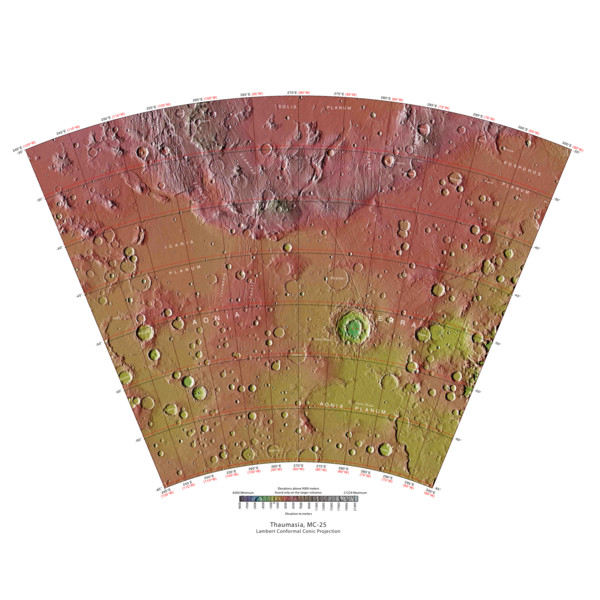
An article published in the journal “Journal of Geophysical Research-Planets” describes a research on the traces of ancient volcanic events that may have affected the climate of the planet Mars. Using data collected by NASA’s Mars Odyssey space probe, a team of researchers led by Don Hood from Louisiana State University (LSU) studied an unusual region of Mars that was called Greater Thaumasia concluding that the mountain ridges that surround it are probably of volcanic origin.
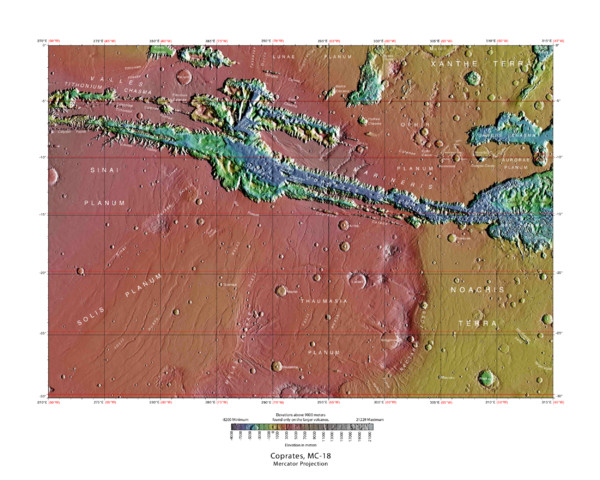
Greater Thaumasia consists of Syria, Solis, and Thaumasia Planae, the Coprates Rise, part of the Thaumasia Highlands, and the transition zone northwest of the Argyre basin and is a region of Mars about as big as North America. In the maps, it’s split in different quadrangles such as the Thaumasia and the Coprates. Also because of that size, its altitude intrigued the researchers, who carried out chemical and mineralogical analyzes of that plateau using data collected by the Mars Odyssey space probe’s Gamma Ray Spectrometer (GRS) instrument.
According to the researchers, the chemical changes detected in Greater Thaumasia areas moving northwestward indicate that the Martian mantle is in constant evolution. In particular an increase of silica and water and a decrease in potassium were seen as evidence that the environment was formed by a series of volcanic events compatible with the formation of the mantle.
The sulfur levels found are also consistent with the kind of events that probably were caused by the deposition of volcanic ashes. Volcanic ashes from various areas could be a sign of explosive volcanism on Mars, an important factor also for its influence on the red planet’s climate. Explosive eruptions emit a lot of gases that can remain in the atmosphere causing global cooling and warming.
Over the years, various research have collected information on the traces of volcanic events on Mars. It’s an important part of the geological research that are reconstructing the red planet’s history because of the possible impacts that a chain of volcanoes might have had on Mars’ climate.

Permalink