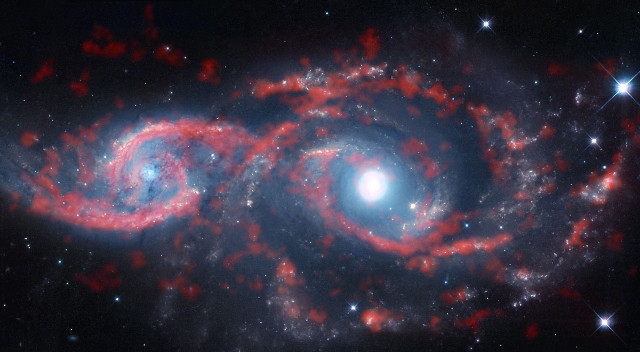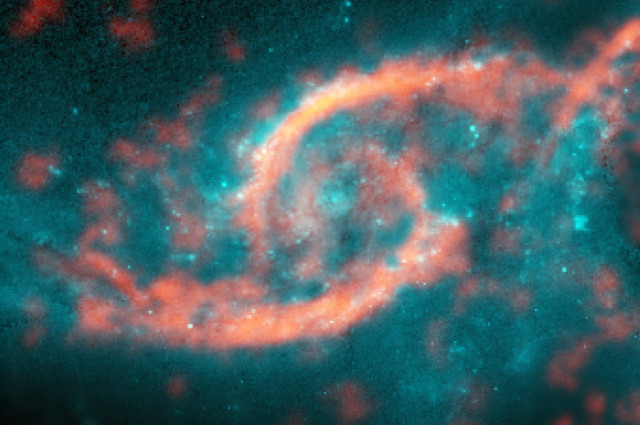
An article published in “Astrophysical Journal” describes a research about the eye-shape galaxy IC 2163, due to a collision with another galaxy called NGC 2207. A team of researchers led by astronomer Michele Kaufman used the ALMA radio telescope to study this kind of tsunami of stars and gas that took on a very rare form among the known galaxies.
IC 2163 and NGC 2207 are two interacting spiral galaxies, meaning that they’re influenced by the mutual gravity pull, that are about 114 million light years from Earth. They were discovered in 1835 by astronomer John Herschel but his telescope wasn’t powerful enough to distinguish them. It was only in 1908 that IC 2163 was described as a separate object. In subsequent years they’ve been the subject of various studies with increasingly sophisticated instruments that could examine the curious structure of IC 2163 with its eye shape with even an eyelid.
Many cases of interacting galaxies have been discovered and of various stages of galactic mergers but rarely a structure with that shape was discovered. That’s because galactic eyelids last only a few tens of million years, a time that may seem incredibly long but from an astronomical point of view is really short, with a joke that could be compared to a blink of an eye for a galaxy.
In the case of IC 2163 and NGC 2207, there are two galaxies that passed close to each other mutually influencing with their gravity. The result was the distortion of the spiral arms’ edges forming the structures we see today. This event could be just the first phase of a series of interaction that will lead in who knows how many millions of years to a merger between these two galaxies.
This research was carried out with the ALMA (Atacama Large Millimeter/submillimeter Array) radio telescope, inaugurated in March 2013, because it was suitable for the purpose of the research, which was to make precise measurements of the motion of the carbon monoxide present in the galactic eyelid IC 2163.
The interest in carbon monoxide is due to the fact that this gas is a tracer of molecular gas, which is the fuel that powers star formation. In the area studied, this gas moves inward at an estimated speed of 100 km/s and then decelerates and its motion become mores chaotic, ending up changing trajectory and aligning with the rotation of the galaxy.
According to astronomers, this type of galactic clash was common when the universe was young and galaxies were closer to each other. The authors of this research are continuing to study IC 2163 and NGC 2207 also by comparing their features with other galaxies pairs studied with ALMA and other instruments such as the Hubble Space Telescope.