
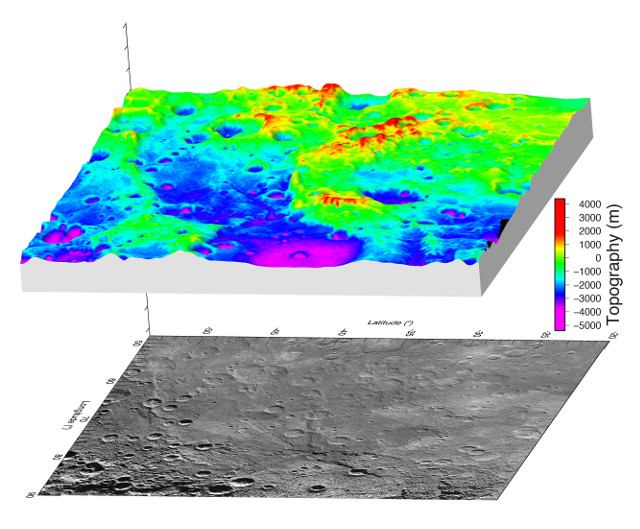
An article published in the journal “Geophysical Research Letters” describes the discovery of a great valley on the planet Mercury. A team of scientists led by Thomas R. Watters of the Center for Earth and Planetary Studies at the Smithsonian’s National Air and Space Museum in Washington, D.C. used topographic maps created thanks to NASA’s MESSENGER space probe to discover it. It’s considered evidence of the planet’s contraction.
The mission of the MESSENGER (MErcury Surface, Space ENvironment, GEochemistry and Ranging) space probe ended with its crash on the planet Mercury at the end of April 2015. As always happens, the data gathered keep on being used for a lot of research. In this case, the stereoscopic images that were used to create high-resolution topographic maps and in one of them a valley emerged clearly that is about 1000 kilometers long (600 miles), about 400 kilometers (250 miles) wide and over 3 kilometers (2 miles) deep.
This huge valley is in Mercury’s southern hemisphere, close to the Rembrandt basin, a large impact crater. In the colorized topographic image, the valley appears in dark blue while the Rembrandt basin appears in purple at the bottom. The geological processes in action on Mercury are quite different from those on Earth because the lithosphere is a single block and not split into tectonic plates so that valley can’t have been generated by tectonic phenomena.
According to the scientists who discovered the valley and have studied it, it’s an indication of the global contraction of the planet Mercury. In essence, its interior is cooling down and therefore is contracting with consequences of this type. The fact that the valley is located between two faults with geological formations similar to cliffs is also considered an indication of the contraction in place.
The processes taking place on Mercury seem different from those observed on Earth. The planet’s cooling process could have started between 3 and 4 billion years ago with the gradual contraction that formed “wrinkles.” This formation could have caused the fractures of lithosphere areas.
In this scenario, scientists wonder if Mercury’s cooling is a constant process. It’s a point still far from clear and some clues suggests that instead there was a warm-up period. The existing models on Mercury’s geological history are still far from perfect and might need to be revised.
In particular, there are traces of recent volcanism and an active magnetic field. In short, the MESSENGER space probe greatly increased our knowledge of Mercury but there’s still something to be discovered. ESA’s BepiColombo mission, scheduled to be launched in 2018, in the next decade could offer new answers.
