
November 2016

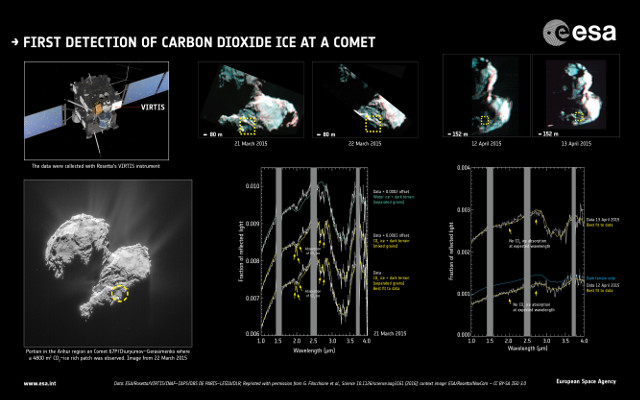
Dry ice detected with its spectral data and indication of the area (Image Data: ESA/Rosetta/VIRTIS/INAF-IAPS/OBS DE PARIS-LESIA/DLR; Reprinted with permission from G. Filacchione et al., Science 10.1126/science.aag3161 (2016); context image: ESA/Rosetta/NavCam – CC BY-SA IGO 3.0)

Two articles published in the journal “Science” describe the discovery of dry ice, meaning frozen carbon dioxide, on the surface of the comet 67P/Churyumov-Gerasimenko. A team of researchers led by Gianrico Filacchione of the Italian National Institute for Astrophysics and another led by Sonia Fornasier the French LESIA-Observatoire de Paris and Université Paris Diderot used the observations conducted with the VIRTIS spectrometer aboard ESA’s Rosetta space probe to find for the first time dry ice on a comet’s nucleus.

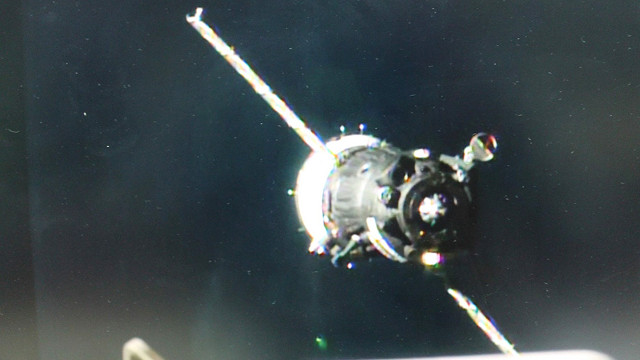
The return capsule of the Shenzhou 11 spacecraft (Photo courtesy Xinhua/Li Gang)

In China was early afternoon when the Shenzhou 11 spacecraft landed in Inner Mongolia. The two crew members, Jing Haipeng and Chen Dong, were assisted by ground staff and are in good physical condition. Their mission began on October 17 so it was the longest Chinese manned mission.

The Soyuz MS-03 spacecraft blasting off atop a Soyuz Rocket (Photo NASA/Bill Ingalls)

It was night in Kazakhstan when the Soyuz MS-03 spacecraft blasted off from the Baikonur Cosmodrome in Kazakhstan carrying Peggy Whitson, Oleg Novitskiy and Thomas Pesquet to ransport them to the International Space Station. It’s the third new version Soyuz spacecraft and was launched once again in the route that will take two days instead of the six-hourt fast path to keep on testing the new on-board systems.

The possible origin of Sputnik Planitia and Pluto's reorientation (Image courtesy James Keane)

Two articles published in the journal “Nature” offer an explanation to the reorientation of the dwarf planet Pluto’s spin axis. The heart of the matter is in the great basin of Sputnik Planitia, formerly known as Sputnik Planum, and it’s appropriate to say it because it’s in the heart-shaped region. According to one of two studies the explanation provides additional clues about the presence of an underground ocean.