November 2016

Illustration of OGLE-2015-BLG-1319: in grey the data from ground-based telescopes, in blue the data from Swift and in red the data from Spitzer (Image NASA/JPL-Caltech)

An article published in “Astrophysical Journal” describes the study of a brown dwarf that orbits a K-type star that was possible thanks to a gravitational microlensing event. An international team of astronomers used NASA’s Swift and Spitzer space telescopes to take advantage of that event, cataloged as OGLE-2015-BLG-1319, at a distance from its star that at which few of those objects were found, hence the name brown dwarf desert.

The comet 67P/Churyumov-Gerasimenko with its two-lobed shape (Photo ESA/Rosetta/NAVCAM)

Two articles to be published in the journal “Astronomy & Astrophysics” describe various aspects of a research on the age of the comet 67P/Churyumov-Gerasimenko. Martin Jutzi and Willy Benz of the University of Bern, Switzerland, together with several colleagues conducted a series of computer simulations to study its two-lobed structure concluding that the collision that gave it its present shape hardly occurred over a billion years ago.

The RX J1615 system (Image ESO, J. de Boer et al.)

Three articles accepted for publication in the journal “Astronomy and Astrophysics” describe as many research on star systems in formation. The research were conducted by different teams of astronomers but have in common the use of the SPHERE instrument mounted on ESO’s VLT (Very Large Telescope), which revealed details never seen before of protoplanetary discs around the young stars RX J1615, HD 97048 and HD 135344B.

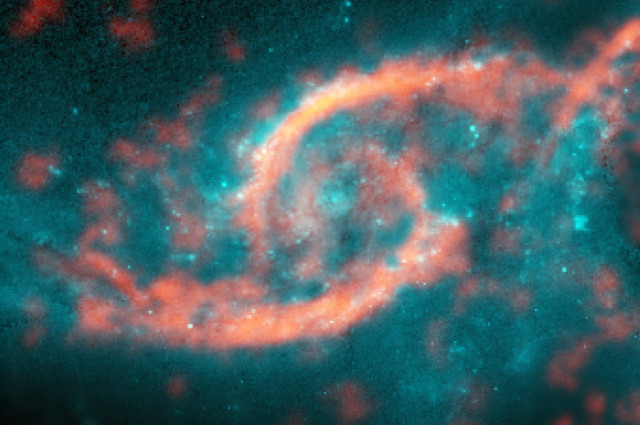
The galaxy IC 2163 (Image M. Kaufman; B. Saxton (NRAO/AUI/NSF); ALMA (ESO/NAOJ/NRAO); NASA/ESA Hubble Space Telescope)

An article published in “Astrophysical Journal” describes a research about the eye-shape galaxy IC 2163, due to a collision with another galaxy called NGC 2207. A team of researchers led by astronomer Michele Kaufman used the ALMA radio telescope to study this kind of tsunami of stars and gas that took on a very rare form among the known galaxies.

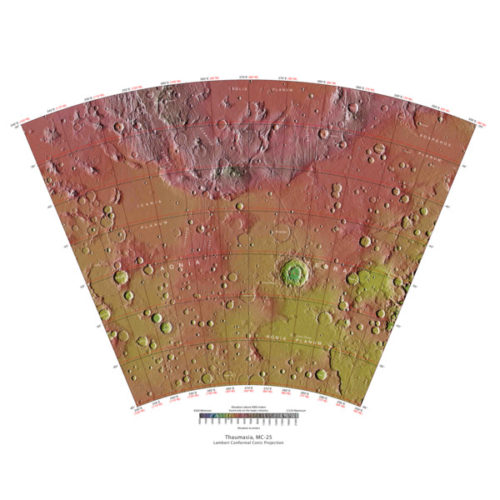
Thaumasia Quadrangle (mage USGS (United States Geological Survey))

An article published in the journal “Journal of Geophysical Research-Planets” describes a research on the traces of ancient volcanic events that may have affected the climate of the planet Mars. Using data collected by NASA’s Mars Odyssey space probe, a team of researchers led by Don Hood from Louisiana State University (LSU) studied an unusual region of Mars that was called Greater Thaumasia concluding that the mountain ridges that surround it are probably of volcanic origin.