
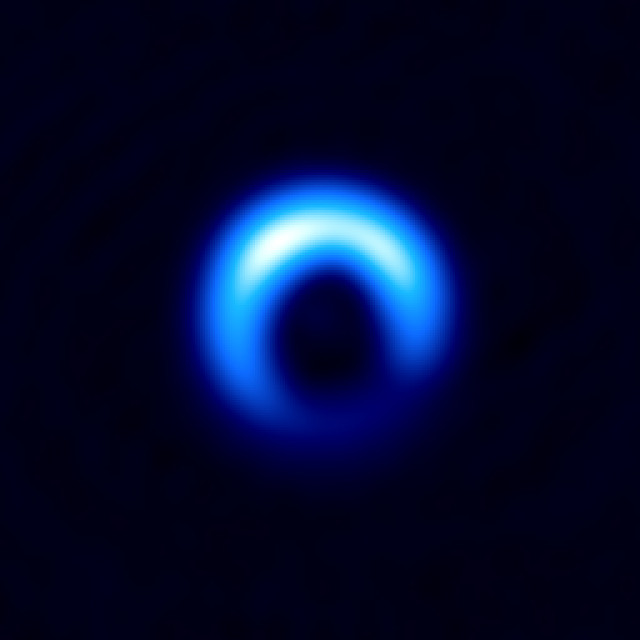
An article published in “The Astrophysical Journal Letters” describes a new research on young system HD 142527. The ALMA radio telescope had already been used in the past to study the protoplanetary disk around the star but this time an international team of astronomers led by Akimasa Kataoka measured with precision the size of the dust particles that form it.
The observations of the HD 142527 system with the ALMA (Atacama Large Millimeter/submillimeter Array) radio telescope started well before it was inaugurated in March 2013 and subsequently completed. This means that the images obtained improved in time until the ones presented in February 2016. In recent years we’re getting used to extraordinary images of planetary systems in formation, spectacular but especially useful to try to understand the secrets of the mechanisms that lead to the birth of planets.
One of the problems in this type of studies is the difficulty in measuring the size of the dust particles that form protoplanetary disks. This is essential to understand how they grow from microscopic particles measuring around one micron up to the end point with fully formed planets but so far the methods used were not precise enough.
The team led by Akimasa Kataoka, a Humboldt Research Fellow at Heidelberg University and the National Astronomical Observatory of Japan (NAOJ), predicted that radio waves around a young star get scattered by dust particles, thus originating unique polarization characteristics. The intensity of those polarized emission allows to accurately estimate the size of the dust particles.
The astronomers created a theoretical model of the polarized emissions and then observed the HD 142527 system with the ALMA radio telescope. The data they gathered turned out to match the predictions showing that the polarization has a radial direction in most of the protoplanetary disk except at its edge, where it becomes perpendicular to the radial direction.
The intensity of the polarized emission observed compared with the models made it possible to estimate the measure of the dust grains. The maximum size was found to be around 150 microns, the first estimate made with this method. It’s a size ten times smaller than that estimated so far, a truly remarkable difference that requires an explanation.
In previous estimates, the researchers’ idea was that dust particles were spherical. In the new study, the astronomers considered the particles as fluffy objects, with complex shapes. The many facets of a particle scatter radio waves and produce unique characteristics in the polarization. The consequence is that the astronomers can trace the microscopic characteristics of the grains.
Thanks to the ALMA radio telescope’s sensitivity it was possible to make progress in the study of protoplanetary disks. The new models developed will be tested with more observations, also of other planetary systems in formation. This application of the method of analysis called polarimetry could finally allow to unravel the secret of planets birth.
