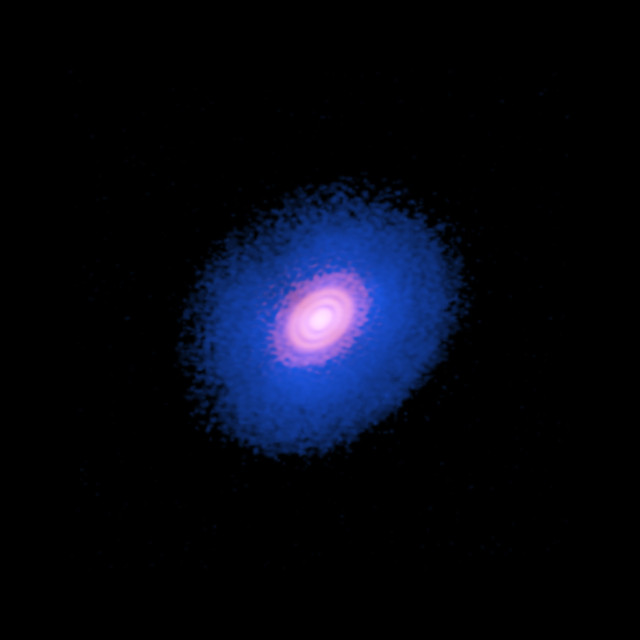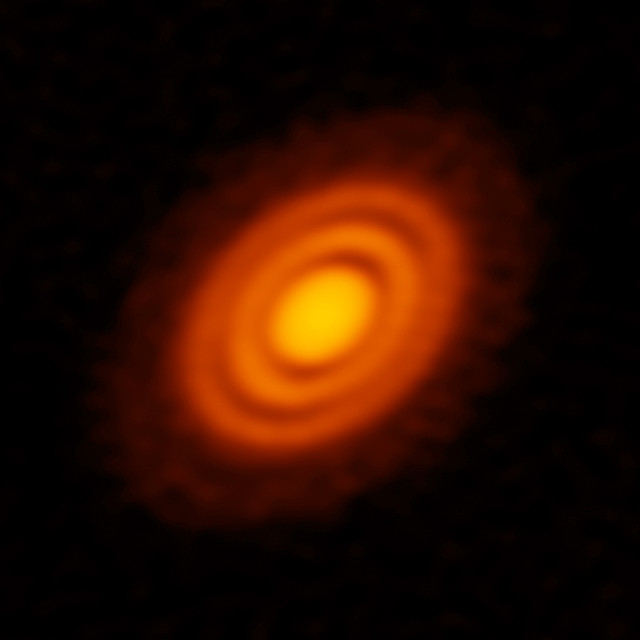
An article published in the journal “Physical Review Letters” describes the evidence of the presence of two newborn planets in the HD 163296 star system. A team of astronomers led by Andrea Isella of the Rice University in Houston used the ALMA radio telescope to study two major gaps that have left a mark in both the dust and in gas portion of the protoplanetary disk surrounding the star.
The HD 163296 system is about 400 light years distant from Earth. The star is about 5 million years old, which means that is very young in astronomical terms, and has a mass about twice that of the Sun. As expected, in this system a protoplanetary disk of gas and dust was discovered. These features make this system an ideal candidate to be studied with instruments such as the ALMA (Atacama Large Millimeter/submillimeter Array) radio telescope.
In fact, the first observations of the HD 163296 system were carried out with the ALMA radio telescope a few years ago but at the time the array of antennas hadn’t yet been completed. ALMA was officially inaugurated in March 2013 and completed in the following months. In essence, only very recently it was possible to take advantage of all this instrument’s power and sensitivity and now researchers are reaping their benefits with investigations such as those of planetary systems in formation.
The observations from a few years ago allowed to see only faint traces of structures within the protoplanetary disk surrounding the star HD 163296. Now that the ALMA radio telescope is fully operational a much greater amount of details could be observed and for the first time astronomers mapped the distribution of both the dust and gas component of disk at a similar level of detail.
These new observations allowed to reveal what now is a ring structure of the protoplanetary disk around HD 163296 and three concentric gaps inside it. The first gap is about 60 astronomical units, meaning it’s 60 times the distance between the Earth and the Sun, from its star, about twice the distance of Neptune from the Sun. The other two gaps are at about 100 and 160 astronomical units, very far as in our solar system that distance exceeds that of the Kuiper belt which hosts dwarf planets and other icy bodies.
The gap closest to its star actually contains gas, to be precise carbon monoxide, in amounts similar to that of the surrounding areas of the protoplanetary disk. In the other two gaps instead the concentration of this gas was much lower, in short they’are empty also from that point of view. For this reason, astronomers deduced that the two outer gaps actually are the orbits of two newborn planets, probably not yet fully formed.
Given the width and depth of the carbon monoxide gaps, the astronomers estimated that the mass of the two planets could be similar to that of Saturn and may still grow. The fact that in the gap closest to its star there’s still an unchanged amount of carbon monoxide suggests that the dust was swept away by a mechanism different from that of planetary formation and this is still interesting and should deserve further research.
This research allowed to take a step forward in the exam of solar systems in their formation process. The ALMA radio telescope, sometimes used with other instruments, opened a new phase in this type of observations and is giving us spectacular images and a lot of important scientific information.