
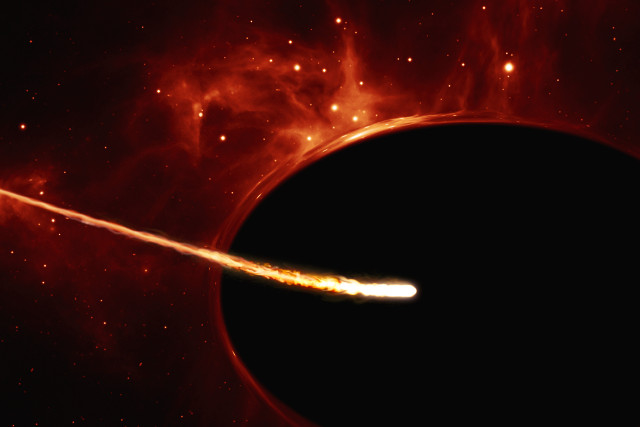
An article published in the journal “Nature Astronomy” describes a research about ASASSN-15lh, which had been classified as a superluminous supernova after it was discovered in 2015. An international team led by Giorgos Leloudas of the Weizmann Institute of Science, Israel, and the Dark Cosmology Centre, Denmark, examined the observations made with various telescopes and concluded that it was actually a star destroyed by a supermassive black hole.
The transient event classified as ASASSN-15lh after being discovered by a project searching for supernovae was so bright that it was visible at a distance of about 3.8 billion light years. Its maximum brightness was twice the brightest supernova observed until that moment. It was such an extraordinary event that it puzzled astronomers, who immediately started wondering what mechanisms could generate such a brightness.
Today the answer might have come from this new research based on observations carried out for ten months after the event with optical telescopes such as the VLT (Very Large Telescope) at ESO’s Paranal Observatory, the NTT (New Technology Telescope) at ESO’s La Silla Observatory and the Hubble Space Telescope. According to the authors, the mechanism that generated ASASSN-15lh was a spinning black hole, also called Kerr black hole, and not an ordinary one but a supermassive black hole with a mass of at least a hundred million times that of the Sun.
Even a black hole so massive would fail to destroy a star outside its event horizon but Kerr blacks holes are characterized by a rapid rotation and this makes all the difference in the effects on nearby objects. According to the researchers, there are several indications that the ASASSN-15lh event was originated by the destruction of a star by a Kerr black hole.
The phases of the ASASSN-15lh event can be interpreted as steps in what is called in the jargon tidal destruction, due to the intense tidal forces arising from the supermassive black hole’s gravity. The burst at ultraviolets and the rise in temperature lower the possibility that it was a supernova. The event occurred in a blue dwarf galaxy, where star formation is very common but superluminous supernovae are not normal.
The evolution of the emissions generated by the ASASSN-15lh event are abnormal for a supernova, not just its peak. In fact, in this case after the peak there was a discontinuous pattern of brightness with decreases alternating with bursts. After a supernova there’s a steady decline in brightness while a star that is destroyed by a Kerr black hole could generate discontinuous emissions with multiple bursts generated by the shock waves developed in the debris of the collision along with the heat produced by the accretion.
The explanation given by the researchers to the ASASSN-15lh event is plausible although it wasn’t established with certainty. We’re talking about an extraordinary event seen from a distance of 3.8 billion light years and is for this reason it took months to explain it as a star destroyed by a Kerr black hole. Discovering other events of this kind would certainly be useful for research.

Permalink