
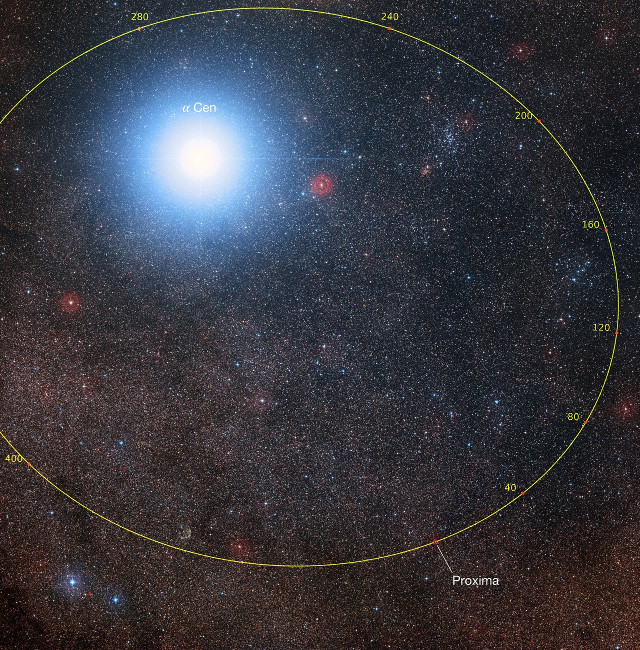
An article published in the journal “Astronomy and Astrophysics” describes the observations that led to conclude that the star Proxima Centauri orbits Alpha Centauri A and B forming a triple system. Astronomers Pierre Kervella, Frederic Thevenin and Christophe Lovis used the HARPS instrument installed at ESO’s La Silla observatory in Chile to obtain the precise measurements needed to support this theory.
Proxima Centauri is a red dwarf star that emits such a dim light that it was detected only in 1915. From the beginning astronomers wondered if it were gravitationally bound to the two Alpha Centauri stars or if it was just passing relatively close to them in a hyperbolic trajectory. Its light is so dim that it made difficult to make precise measurement of its radial velocity, that is its speed in the direction of the line of view, in this case the line between the star and the Earth.
The HARPS (High Accuracy Radial velocity Planet Searcher) instrument, as the name suggests, is designed to search for planets but its features made it suitable for this research allowing precise measurements of Proxima Centauri’s radial velocity. Their accuracy was further improved accounting for other effects such as the fact that it’s a flare star that has a variability that can create problems in the detections.
According to the astronomers who conducted this research, Proxima Centauri’s radial velocity is very similar to that of the Alpha Centauri pair. This supports the theory that there is a gravitational bond among the three stars because Proxima’s velocity relative to the other two is well below the limit beyond which there wouldn’t be a gravitational bond.
Using the information gathered, the astronomers estimated, even if in approximate terms, the characteristics of Proxima Centauri’s orbit around the Alpha Centauri pair. Proxima Centauri’s orbital period is around 550,000 Earth years in a very elliptical orbit where the minimum distance from the other two stars is about 4,300 times that of the Earth from the Sun and the maximum distance is about 13,000 times that of the Earth from the Sun.
The fact that Proxima Centauri form a triple system together with Alpha Centauri A and B suggests several considerations. First of all, the three stars were probably born together and consequently are the same age. The study of the Alpha Centauri pair has always been easier because they have a size similar to that of the Sun so we know that their age is about 6 billion years. This means that Proxima Centauri is probably that age as well and the same goes for Proxima b, the exoplanet whose discovery was announced by ESO in August 2016.
After that announcement, Proxima b has become the subject of a considerable number of hypotheses and speculations, probably inevitable given that it’s the planet outside the solar system closest to Earth, about 4.25 light-years away, in astronomical terms in the neighborhood. The astronomers who conducted the new research have added their speculations as well, in particular on the possibility that this planet formed farther from Proxima Centauri then got closer or that it even formed at the edge of one of the two stars’ system only to be captured by the third one.
There are many hypotheses based on limited data but the discovery of Proxima b really stimulated the imagination. About Alpha Centauri, in November the International Astronomical Union (IAU) established that the official name of the pair is Rigil Kentaurus, the old name derived from the one given by the Arabs that means “the foot of the centaur”. The name Alpha Centauri will still be used.
