2016

An image of the HD 142527 binary star system from observations made with the ALMA radio telescope (Image Andrea Isella/Rice University; B. Saxton (NRAO/AUI/NSF); ALMA (NRAO/ESO/NAOJ)

At the meeting of the AAAS (American Association for the Advancement of Science) just concluded in Washington, D.C. the latest results were presented about the observations of the HD 142527 star system carried out with the ALMA radio telescope. It’s been an object of study by astronomers for some time and is particularly interesting because it’s very young. This means that around the central star there’s a ring of gas and dust that is probably forming one or more planets but there’s also a second star. This type of study will help to understand the formation of planets in binary systems.

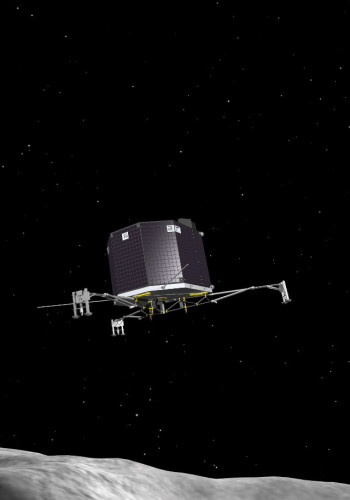
Artist's impression of the Philae lander (Image ESA–J. Huart)

The hopes to be able to contact the lander Philae on the comet 67P/Churyumov-Gerasimenko’s surface have now faded and ESA is also pessimistic. DLS, the German space agency, runs the LCC (Lander Control Center) and in recent months tried to re-establish contact after Philae communicated for a while on several occasions but issued a statement declaring that it’s time to say goodbye to the lander.

Panoramic view of the galaxies in the local supercluster (Image IPAC/Caltech, by Thomas Jarrett)

An article published in the journal “Astronomical Journal” describes a research that offers at least a partial explanation for the cosmic phenomenon called the Great Attractor. An international team used the 64-meter Parkes radio telescope in Australia to make observations through the galactic Zone of Avoidance, an area of space obscured by the Milky Way itself with its stars and dust clouds. In this way the researchers found hundreds of previously unknown galaxies, ea progress in the gravitational anomaly’s explanation.

The gravitational waves detected by LIGO (Image courtesy LIGO)

In Washington, D.C. a press conference was held to announce that the LIGO experiment found the gravitational waves predicted by Albert Einstein’s theory of general relativity. Two blacks holes about 1.3 billion light years from Earth merged as a result of a collision emitting those waves.

LIGO (Laser Interferometer Gravitational-Wave Observatory) is an instrument designed specifically to detect gravitational waves. It was created in a collaboration between Caltech (California Institute of Technology) and MIT (Massachusetts Institute of Technology) with funding from the American NFS (National Science Foundation).

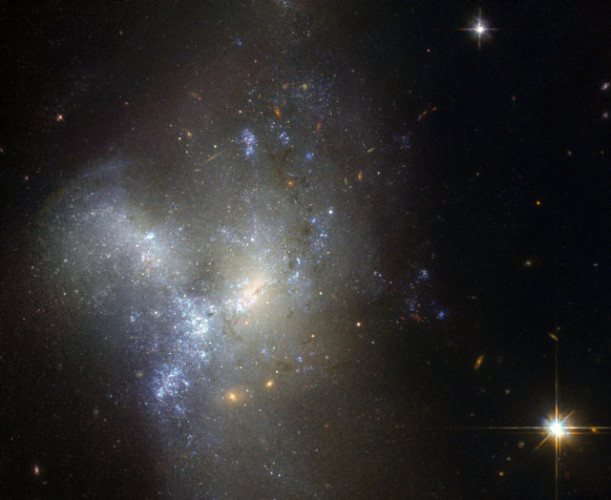
The galaxy NGC 1487 photographed by the Hubble Space Telescope (Image ESA/Hubble & NASA / Judy Schmidt)

The Hubble Space Telescope photographed a really peculiar galaxy called NGC 1487. It was defined an event rather than a celestial object because it’s the result of a merger between two but perhaps even more galaxies that formed something very different. Astronomers are unable to say how many galaxies were involved in the phenomenon nor what they looked like. This merger probably caused the birth of many new giant stars.