
2016

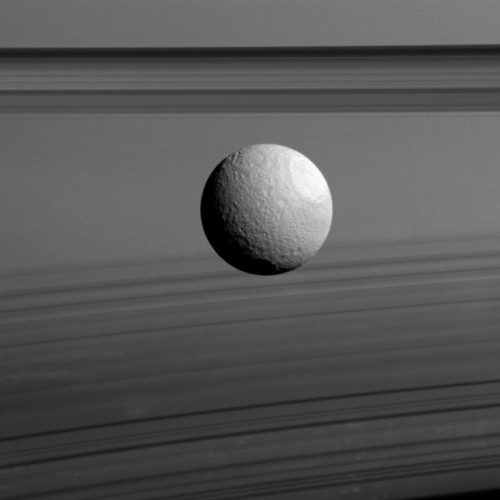
Saturn's moon Tethys with the planet's rings in the background (Image NASA/JPL-Caltech/Space Science Institute)

NASA has published a photograph taken by the Cassini space probe that frames Tethys, one of Saturn’s moons, in front of the planet’s rings. They have such a relative position Tethys seems to float between two sets of rings but it’s just an optical effect. The result is a particularly striking image even by the standards of a mission that has been offering stunning portraits of the planet Saturn, its rings and its moons.

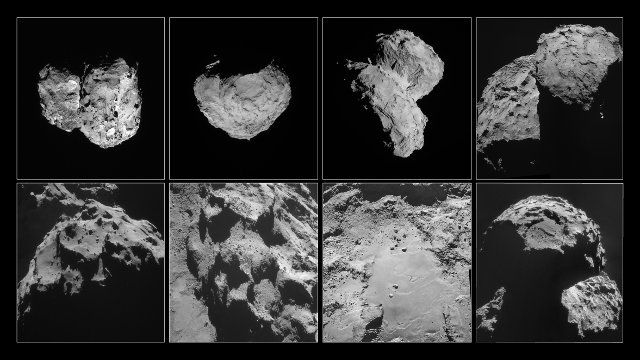
Pictures of the comet 67P/Churyumov-Gerasimenko taken by the Rosetta space probe between August and November 2014 (Image ESA/Rosetta/NavCam – CC BY-SA IGO 3.0)

An article published in the journal “Nature” describes a research about the internal structure of the comet 67P/Churyumov-Gerasimenko. A team of scientists, led by Martin Pätzold, from Rheinische Institut für Umweltforschung an der Universität zu Köln, Germany, analyzed data collected by ESA’s Rosetta space probe to provide some answers to the astronomers’ questions. According to their findings, the comet’s internal structure is quite homogeneous and contains no large caves. The total mass was estimated at nearly 10 billion tons.

Picture of Pluto and the Sputnik Planum area with its floating hills (Image NASA/JHUAPL/SwRI)

NASA scientists found a new geological activity on the dwarf planet Pluto which is truly unique: there are floating hills that move over time, albeit at very low speeds. These hills in the area informally called Sputnik Planum are probably smaller versions of the great mountains at the western border of the area. For their behavior, they have been compared to the Earth’s icebergs.

Simulation of the Sun's magnetic field in January 2011 (on the left) and July 2014 (on th right) (Image NASA's Goddard Space Flight Center/Bridgman)

Using data obtained by its SDO (Solar Dynamics Observatory) space probe, NASA scientists have created a simulation of the solar magnetic field. This represents an aid in the understanding of its influence on what happens in the Sun, a series of phenomena that have important effects in the solar system. Solar explosions causing auroras are the most visible consequence but there are also other ones such as the interplanetary magnetic field and the radiation that spacecraft must go through to travel through the solar system.

Perspective view in Noctis Labyrinthus (Image ESA/DLR/FU Berlin, CC BY-SA 3.0 IGO)

ESA has published new photographs of Noctis Labyrinthus (labyrinth of the night), taken by its Mars Express space probe on July 15, 2015. It’s a mountain range in the western side of Valles Marineris, a huge complex of canyons on the planet Mars, near its equator. Its complex structures were created by the breaking of the crust of the Tharsis region, which caused deep fractures.