
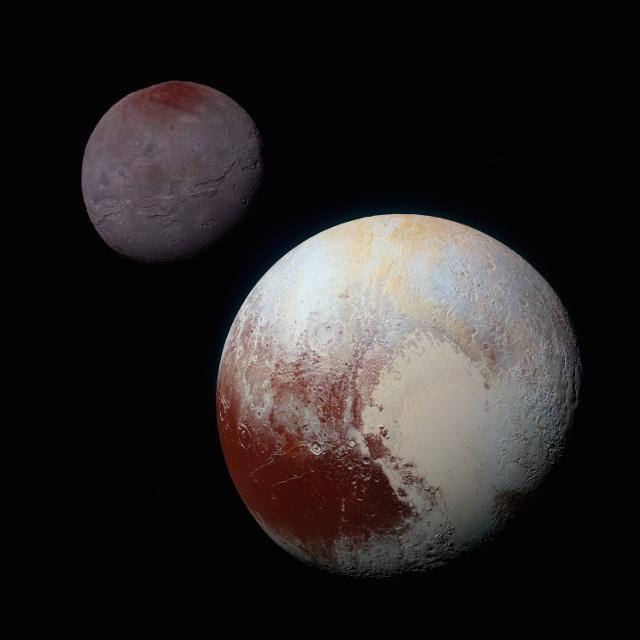
An article published in the journal “Icarus” describes a research on Charon, the biggest moon of the dwarf planet Pluto, and on one aspect of the relationship between the two of them. A team of researchers at the Georgia Institute of Technology made a series of computer simulations that indicate that the passage of Charon between Pluto and the Sun slows the dwarf planet’s atmosphere loss. The predictions are consistent with the data collected by NASA’s New Horizons space probe.
Ever since Charon was discovered in 1978, astronomers regarded with curiosity the relationship between it and Pluto because of their unique situation. We’re used to a very large moon because the Earth’s one is very large but Charon has a diameter that is greater than half of Pluto’s and its average distance from the dwarf planet is less than 20,000 kilometers (almost 12,500 miles). For this reason, many astronomers believe that it would be more correct to speak of a pair of twin dwarf planets instead of a dwarf planet and its moon.
The relationship between the size of Pluto and Charon and their proximity has some interesting effects. For example, solar eclipses are a sort of shield to Pluto’s atmosphere. Previous calculations suggested that Pluto had an atmospheric loss rate one hundred times greater than that actually observed by the New Horizons space probe’s instruments in particular during its extraordinary July 14, 2015 flyby.
The team at the Georgia Institute of Technology made computer simulations before that flyby and the comparison with the data collected by the New Horizons space probe showed a consistency between them. The journal “Icarus” already published a research regarding Pluto’s atmosphere in September 2016, now these computer models can provide some more details on its interaction with solar wind.
Despite its distance from the Sun, Pluto is being stripped of its atmosphere by solar wind but at a very slow pace so it still has an amount of volatile elements much greater rate than the inner planets, which are hammered by solar wind. This is useful to better understand what compounds were common on the solar system’s planets when it was young and how the various atmospheres evolved.
