
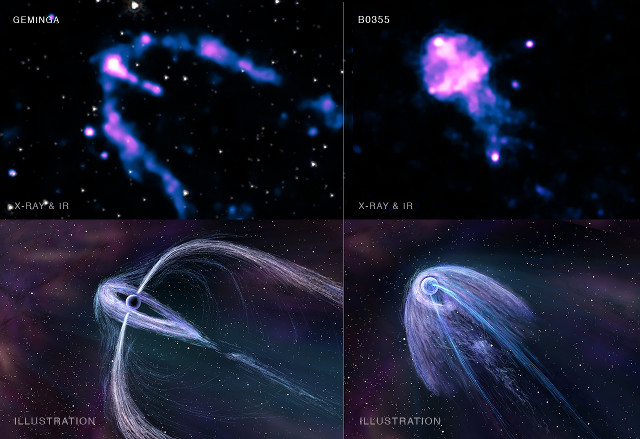
Two articles published in “The Astrophysical Journal” describing research on as many pulsar that allow to better understand the geometry of the plasma in their vicinity. Two independent team used NASA’s Chandra space telescope to study the pulsar Geminga, also known as PSR B0633+17, and PSR B0355+54 gathering information on the nebulas of high-energy particles called in jargon plerions generated by the pulsars.
Neutron stars are objects on which questions seem to increase more than the answers that astronomers find about them. Recently, a research was published that may have found information about the link between the two types of these stars, pulsars and magnetars, but there’s still much to understand. For example, many pulsars generate emissions of radio waves and gamma rays, some show only radio wave emissions and others gamma rays only.
To try to better understand the situation, a number of research have been carried out since those differences have been a source of much debate. Among them there’s a campaign of observations involving six gamma ray emitting pulsars led by Roger Romani of Stanford University. These pulsars have a series of very different characteristics, useful to test the emission patterns of these neutron stars. Thanks to the Chandra space telescope, it was possible to reconstruct the three-dimensional structure of their nebulas.
The pulsar Geminga, which stands for “Gemini gamma-ray source” as it’s visible in the Gemini constellation, is one of the pulsars closest to the Earth being “only” a little more than 800 light-years away. It was studied by a team led by Bettina Posselt of Pennsylvania State University. This pulsar is surrounded by a very special nebula, with three tails that stretch for more than half a light-year. It emits gamma-ray pulses but not radio waves.
The pulsar PSR B0355+54 is about 3,300 light years from Earth and has been studied by a team led by Noel Klingler of George Washington University. The nebula that surrounds it seems a kind of hat on one side and a twin tail on the other, extending for almost five years light from the pulsar. It’s one of the brightest pulsars known at radio frequencies but doesn’t emit gamma rays.
According to Bettina Posselt, who is also among the authors of the research on the pulsar PSR B0355+54, the nebula structures can help understand the differences in emissions. Perhaps Geminga has magnetic poles we see near the horizon and its axes almost aligned. Instead, PSR B0355+54 seems to have a magnetic pole directed towards the Earth.
According to the theory the researchers sought to verify, radio waves are emitted near the poles while gamma rays are emitted from more distant areas of the pulsar and spread to wider areas of the sky. For this reason, we see the pulsars emission depending on their position relative to the Earth and as a consequence gamma rays coming from Geminga and radio waves from PSR B0355+54.
The interpretations of the researchers are plausible but they need to be checked, also to rule out others. The observations with the Chandra space telescope are allowing us to study pulsars in depth to obtain those results. These extreme objects with their powerful magnetic fields and their emissions are also useful to study other astrophysical phenomena.
