
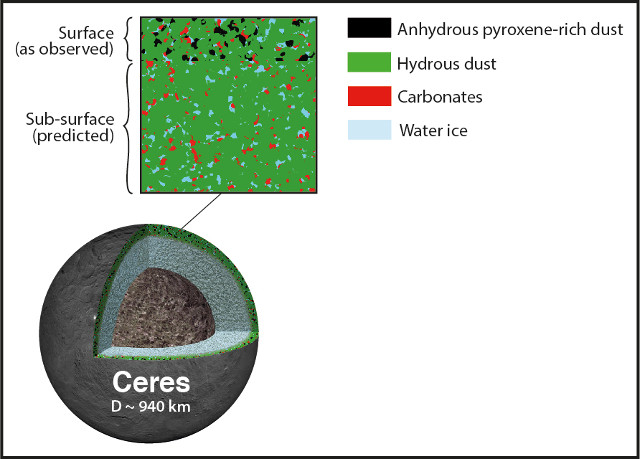
An article published in “The Astronomical Journal” describes a research on the surface of the dwarf planet Ceres. Using infrared observations carried out with the SOFIA observatory a team of scientists of the Laboratoire d’Astrophysique de Marseille, SETI and NASA’s JPL identified the presence of pyroxene, clay and carbonates that so far deceived the researchers, who thought the surface was rich in carbon compounds.
We got used to read the results of research on the dwarf planet Ceres based on data from NASA’s Dawn space probe but occasionally some are conducted with a telescope. In this case, it’s the flying infrared SOFIA (Stratospheric Observatory for Infrared Astronomy) observatory, a project of NASA and DLR, the German space agency, which uses a modified Boeing 747SP to allow the use of a telescope of 2.5 meters in diameter.
Ceres was classified as a dwarf planet since the creation of this category of objects but was classified as a C-type asteroid for what appeared to be its composition. This class of asteroids is the most common and includes the carbonaceous ones, which are rich in carbon compounds. The SOFIA observatory allowed to conduct observations in the mid-infrared, which means at electromagnetic frequencies that are able to identify the composition of Ceres’ subsoil despite what seem strong contamination of materials coming from elsewhere.
The results of the observations made by the SOFIA observatory show a situation different from what seemed granted. They indicate that Ceres, the largest celestial body of the asteroid belt between Mars and Jupiter, is quite different from its neighbors and this leads to rethink the relationship that exists between them. In particular, the observations show a very fine layer of pyroxene, a dry silicate – which is why it’s referred to as anhydrous pyroxene in the image – that adds to the already known presence of clay dust (hydrous dust in the image), carbonates and water ice.
According to the researchers, pyroxene comes from interplanetary dust particles, an important source of materials that accumulated on the surface of other asteroids. They can also have arrived on Ceres giving it an appearance similar to that of C-type asteroids.
The influence of alien materials on a celestial body’s look is an already known phenomenon, for example for the reddish material found on Charon, Pluto’s main moon. The two-faces of Iapetus, a moon of Saturn, are a consequence of this type of phenomenon too.
The idea that Ceres’ composition was similar to that of its neighbor asteroids was considered evidence that they formed in the same area. If the composition is different, and especially because of the presence of clay materials and ammonia the hypothesis that Ceres formed in an outer area of the solar system and then moved to its current position is more plausible.
