
February 2017

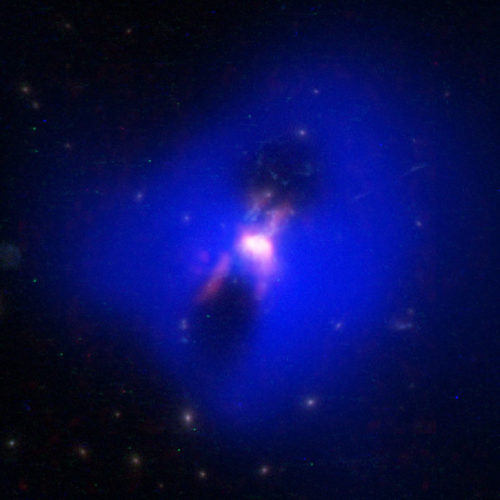
Active galaxy in the heart of the Phoenix Cluster with its jets (Image ALMA (ESO/NAOJ/NRAO) H.Russell, et al.; NASA/ESA Hubble; NASA/CXC/MIT/M.McDonald et al.; B. Saxton (NRAO/AUI/NSF))

An article published in “Astrophysical Journal” describes a research showing a link between a supermassive black hole and the galaxy that hosts it. A team of researchers used the ALMA radio telescope to study a galaxy in the heart of the Phoenix Cluster which has at its core a supermassive black hole that emits electromagnetic radiation jets that are stimulating the birth of new stars.

Mercury's north pole. In red the area in shadow. In yellow the ice. (Image NASA/Johns Hopkins University Applied Physics Laboratory/Carnegie Institution of Washington/National Astronomy and Ionosphere Center, Arecibo Observatory. Updated from N. L. Chabot et al., Journal of Geophysical Research, 117)

An article published in the journal “Icarus” describes a study on the water ice existing in the shadow of several craters of the planet Mercury that aimed to estimate tis amount, which could be much higher than that predicted with glaciers tens of meters thick. The estimates are still approximate and there are still a number of hypotheses about the origin of that water.

The Magellanic Clouds (Image V Belokurov, D Erkal, A Mellinger)

An article published in the journal “Monthly Notices of the Royal Astronomical Society” describes the evidence gathered of the existence of a bridge of stars between the two Magellanic Clouds, the two dwarf galaxies satellite of the Milky Way. An international team led by astronomers from the University of Cambridge used data collected by ESA’s Gaia space probe to determine that the bridge is composed not only of gas but also of stars that are old and were stripped from their galaxies.

The Sun during a solar flare (Image NASA/NOAA)

NASA released an image of the solar flare occurred on January 21 captured by the GOES-16 satellite that the agency runs with NOAA using the Extreme Ultraviolet and X-Ray Irradiance Sensors (EXIS) instrument. It’s specifically aimed to observe the Sun and monitor phenomena such as solar storms, which can have consequences on the activity of satellites but also of power plants and other human activities.

Artist’s impression of the AR Scorpii system (Image M. Garlick/University of Warwick/ESO)

An article published in the journal “Nature Astronomy” describes the discovery of the first white dwarf pulsar, an object so far only hypothesized but never found. A team of researchers from the British University of Warwick identified it in the AR Scorpii (AR Sco) System, composed of a red dwarf and the white dwarf pulsar that a rotation period of just under two minutes.