March 2017

Arsia Mons (Image NASA/JPL/USGS)

An article published in the journal “Earth and Planetary Science Letters” describes a research about Arsia Mons, a volcano on the planet Mars. A team led by Jacob Richardson of NASA’s Goddard Space Flight Center examined high-resolution images taken by the MRO (Mars Reconnaissance Orbiter) space probe to determine that Arsia Mons was at its peak of activity about 150 million years ago and that its last activity probably ended about 50 million years ago.

Phases of the collapse at Aswan (Image ESA/Rosetta/NavCam – CC BY-SA IGO 3.0; ESA/Rosetta/MPS for OSIRIS Team MPS/UPD/LAM/IAA/SSO/INTA/UPM/DASP/IDA)

Two articles, one published in the journal “Nature Astronomy” and one published in the journal “Science”, describe two studies about the comet 67P/Churyumov-Gerasimenko. The first is about a cliff Aswan in the Seth region of the comet’s nucleus that crumbled. The second article is about the changes that occurred on the comet’s surface detected thanks to ESA’s Rosetta space probe between the summer of 2014 and September 2016.

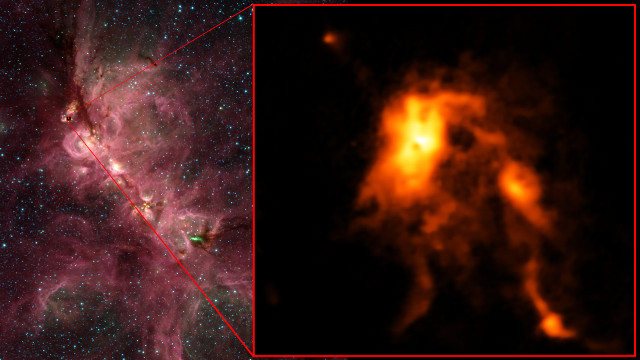
The Cat's Paw Nebula and the protostar NGC 6334I-MM1 (Image ALMA (ESO/NAOJ/NRAO), T. Hunter; C. Brogan, B. Saxton (NRAO/AUI/NSF); GLIMPSE, NASA/JPL-Caltech)

An article published in “Astrophysical Journal Letters” describes the study of a protostar indicated as NGC 6334I-MM1 which increased its brightness 100 times. A team led by astronomer Todd Hunter of the National Radio Astronomy Observatory (NRAO) discovered this transformation by comparing new observations carried out with the ALMA radio telescope with other ones previously carried out with the SMA radio telescope.

Artist's impression of the X9 system with the view from Chandra X-ray Observatory in the inset (Image X-ray: NASA/CXC/University of Alberta/A.Bahramian et al.; Illustration: NASA/CXC/M.Weiss)

An article published in the journal “Monthly Notices of the Royal Astronomical Society” describes a research on what appears to be a binary system including a star with the closest orbit around a black hole. A team of astronomers used NASA’s Chandra X-ray Observatory and NuSTAR space Telescope and the Australia Telescope Compact Array (ATCA) to observe this system called X9 concluding that the star, a white dwarf, takes 28 minutes to orbit the black hole.