
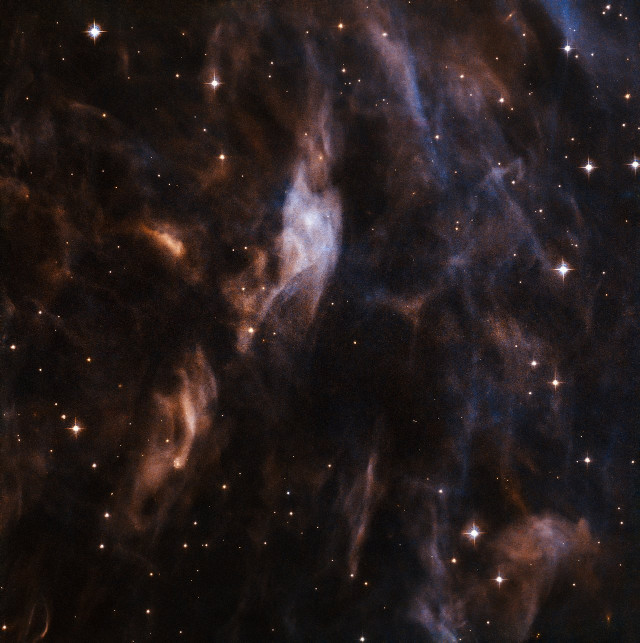
An image captured by the Hubble Space Telescope shows part of a nebula called Sh2-308 surrounding the star EZ Canis Majoris, a Wolf-Rayet star, a rare type of very massive star, over twenty times the mass of the Sun, and very hot that emits very strong solar winds. The star and the nebula are closely linked because the very strong solar winds push large amounts of ionized hydrogen that form a kind of temporary bubble around it.
This image was produced by putting together several photos taken from the Hubble Space Telescope’s Advanced Camera for Surveys (ACS) instrument with four different filters to sample different wavelengths. In this case, the ACS worked with another instrument, the Wide Field Camera 3 (WFC3): while the ACS was aiming to the target to be observed, the WFC3 was aiming to a nearby area of the sky so that it was possible to keep an eye on potentially interesting regions at the same time.
The star EZ Canis Majoris (EZ CMa), also known as HD 50896 and with a number of other designations depending on the catalog, is about 5,000 light years away from Earth. It’s one of the brightest Wolf-Rayet stars known so far and this brightness means it’s extremely hot, a characteristic also indicated by the spectral WN4 type with which it was classified.
The life cycle of a Wolf-Rayet star is very fast in astronomical terms as it pushes out such amounts of ionized hydrogen that in less than 100,000 years their mass can get halved. The consequence is that the nebulae created by that hydrogen will no longer receive any more materials: at that point they will start dispersing until the star at their center explodes in a supernova and finally destroys the nebula.
Nebulae such as Sh2-308 can be spectacular in their entirety for their bubble shape, especially when a perspective trick with EZ Canis Majoris, another star and various emissions seem to form a face. However, for astronomers the details of that gas shell are also interesting to study to understand how it’s changing over time in its interactions with a very active star at its center.
