
May 2017

The Fomalhaut system seen by ALMA and Hubble (Image ALMA (ESO/NAOJ/NRAO), M. MacGregor; NASA/ESA Hubble, P. Kalas; B. Saxton (NRAO/AUI/NSF))

Two articles to be published in “The Astrophysical Journal” describe two studies concerning the ring of debris surrounding the star Fomalhaut. An international team of astronomers used the ALMA radio telescope to get the first complete image of those debris, which are probably the product of a series of collisions among comets near the outer edges of that solar system. Carbon monoxide and carbon dioxide have also been found in abundance.

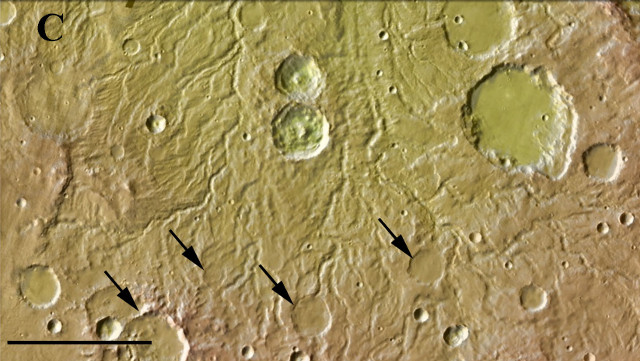
Valleys on Mars eroded by rainfall (Image courtesy Elsevier)

An article published in the journal “Icarus” describes a research on rainfall on the young planet Mars. Geologists Robert Craddock of Smithsonian Institution and Ralph Lorenz of Johns Hopkins University Applied Physics Laboratory showed how the changes in the Martian atmosphere caused an increase in rainfall, which had effects on the surface of the planet similar to those we see on Earth.

2007 OR10 and its moon (Image NASA, ESA, C. Kiss (Konkoly Observatory), and J. Stansberry (STScI))

An article published in “The Astrophysical Journal Letters” describes the discovery of a moon of the 2007 OR10 transnettunian object. It’s most likely a dwarf planet which is still little known because right now it’s distant from the Sun about 87 times the Earth. A team of astronomers led by Csaba Kiss of the Konkoly Observatory in Budapest analyzed images of the Hubble Space Telescope’s archive finding two images of 2007 OR10’s moon.

Composite image of the Crab Nebula (Image NASA, ESA, G. Dubner (IAFE, CONICET-University of Buenos Aires) et al.; A. Loll et al.; T. Temim et al.; F. Seward et al.; VLA/NRAO/AUI/NSF; Chandra/CXC; Spitzer/JPL-Caltech; XMM-Newton/ESA; and Hubble/STScI)

An article published in “The Astrophysical Journal” describes a new research on the Crab Nebula based on images that embrace a large part of the electromagnetic spectrum because they got assembled by bringing images at different wavelengths together. These supernova remnants were portrayed by five telescopes: VLA radiotelescope (radio waves) in red, Spitzer Space Telescope (infrared) in yellow, Hubble Space Telescope (visible) in green, XMM-Newton (ultraviolet) in blue, and Chandra X-ray Observatory (X-ray) in purple.

A panorama of the area accessing Perseverance Valley (Image NASA/JPL-Caltech)

NASA’s Mars Rover Opportunity has begun its scientific work in yet another Mars area to be explored during a mission that has been going on for over 13 Earth’s years. This mission was extended for the tenth time in 2016 and now its goal is to study “Perseverance Valley”, an ancient valley on the inner slope of the Endeavor crater’s rim to figure out how it formed.