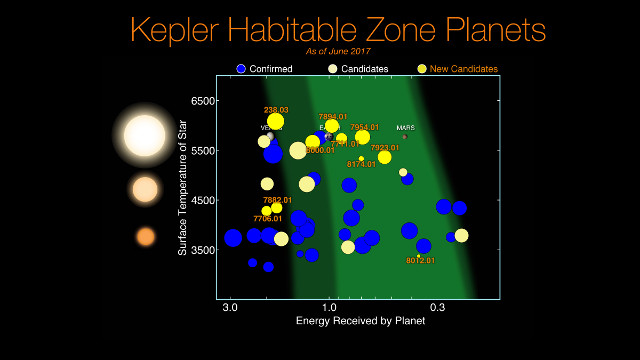
At a press conference, NASA presented the new catalog of exoplanet candidates produced thanks to the observations of its Kepler space telescope. Exoplanet candidates are a total of 4,034 of which 2,335 have been confirmed as actually existing. There are 219 new candidates, of which 10 might be similar to Earth and at the same time be in their solar system’s habitable zone.
The catalog presented by NASA is the final one because it’s based on all the data collected during the first four years of the Kepler space telescope’s mission observing a portion of the sky in the Cygnus constellation. In essence, in what in astronomical terms is a small area of space in the course of four years more than 4,000 exoplanet candidates have been found orbiting stars comparable to the Sun. The verification work is long and complex but surely many other exoplanets will be confirmed in addition to the 2,335 already announced.
The 219 new candidates were discovered by reprocessing all the data collected between 2009 and 2013 during the Kepler space telescope’s primary mission. Over the years scientists learned a great deal greatly improving the exoplanet recognition techniques so old data can show the possible presence of other exoplanets with new types of analysis.
Of the many candidates, nearly 50 have Earth-like size and are in their solar system’s habitable zone and over 30 of them have already been verified. The new 10 candidates might offer other interesting surprises and become candidates for further future observations with other telescopes. About 2,000 exoplanets of the Kepler catalog have already been observed with the W.M. Keck telescope in Hawaii in order to measure their size and their stars’ size with great precision.
The results were very interesting because they allowed to classify low-mass planets, comparable to Earth, in two classes. About 75% of the rocky exoplanets are larger than Earth but for reasons still to be understood about half of them have an amount of hydrogen and helium that makes them larger and turns them into mini-Neptunes. These are gas planets, without a solid surface but with a very thick atmosphere where Earth-like life forms can’t develop.
An interesting consequence of this new discovery is that our solar system seems to be an exception since it has relatively small rocky planets and massive gas planets. In particular, the strangeness is that there’s no mini-Neptune, which seems such a common type. This can be connected to various hypotheses such as the possible planet far farther than Pluto or the one about one the solar system’s that got lost in space in the past.
Inevitably, however, the most interesting exoplanets are those in their systems’ habitable zone. At the moment it’s difficult even to find out if a verified exoplanet has an atmosphere so it will take a long time to know something about the 10 new candidates. Even if they were all verified, for what we know now they could be all balls of rock with no atmosphere and therefore completely dead.
Nowadays, these announcements get noticed by the general public only when they are offered with sensationalistic tones but the progress made in just over twenty years since the discovery of the first exoplanets is huge. Over the next few years, with the construction and launch of new telescopes, space and ground-based, we can expect further leaps forward.