
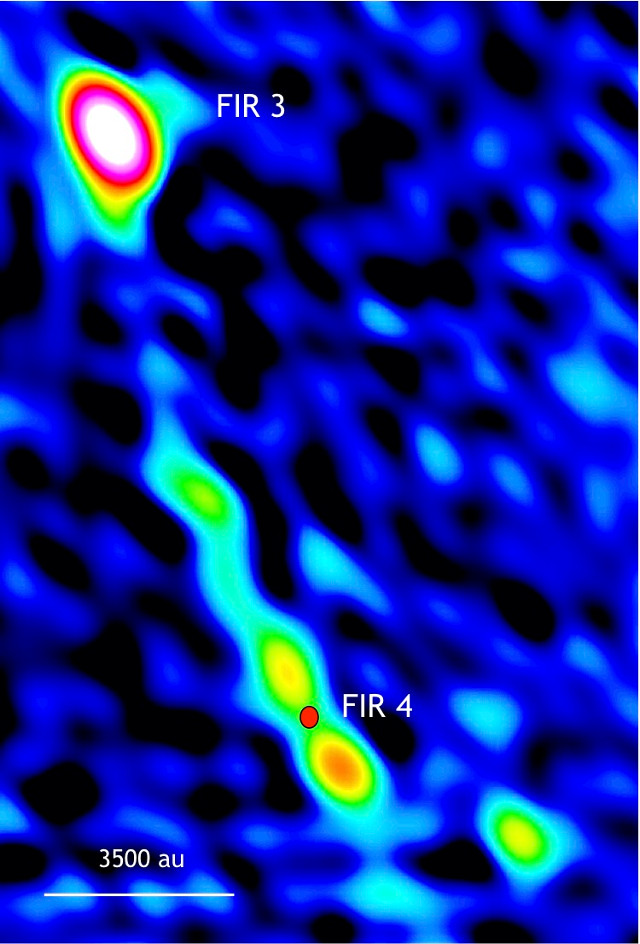
An article published in the “Astrophysical Journal” describes a research on a star formation phenomenon in the Orion Molecular Cloud 2. A team of Astronomers led by Mayra Osorio of the Astrophysical Institute of Andalucia (IAA-CSIC) in Spain used the VLA radio telescope to find the evidence that a jet of material ejected by a young star might have triggered the formation of another younger protostar.
The astronomers put together data collected from observations made within the Orion Molecular Cloud 2 (OMC-2 of far-infrared sources between 1994 and 2015. They focused in particular on two far infrared (Far InfraRed, FIR) sources called FIR 3 and FIR 4. They are also known respectively as HOPS 370 and HOPS 108 in the Herschel Orion Protostar Survey (HOPS) catalog.
These are objects that have already been studied in the past and that’s also why they are identified in different ways. OMC-2 is an interesting gas cloud for the star-forming phenomena ongoing within it. New observations were made not at infrareds but in radio frequencies using the VLA (Very Large Array) radio telescope. This allowed to reveal new details and what seem evidence of a connection between HOPS 370 and HOPS 108.
The images of the young protostar HOPS 108 show that it’s on the trajectory of an outflow from HOPS 370, a star that’s a bit older. Already in 2008 these two objects were observed by a team led by the astronomer Yoshito Shimajiri, who suggested that the materials that formed that outflow had caused a shock in a clump of gas triggering its collapse into a new star.
Now the team led by Mayra Osorio has announced the discovery of knots of materials within that outflow and the measurement of their speed. According to their reconstruction, the jet from HOPS 370 started hittin the clump of gas about 100,000 years ago. The schock caused by the clump of gas’ compression caused the collapse that eventually led to the formation of HOPS 108.
There may be other cases of such interaction within that molecular cloud but it’s difficult to find evidence. Even in the case of HOPS 370 and HOPS 108, the protostar seems to be moving quickly with a trajectory that suggests that it may have formed in an area other than that hit by the outflow creating doubt about its origin.
The researchers must now try to figure out whether that movement started before its formation or it’s a consequence of a push originated by an outflow coming from the protostar itself. For this reason they intend to continue the observations and collect data for a longer period of time so that they can better understand the motion of HOPS 108. A confirmation of its interaction with HOPS 370 would make it an interesting case of star formation within molecular clouds.
