
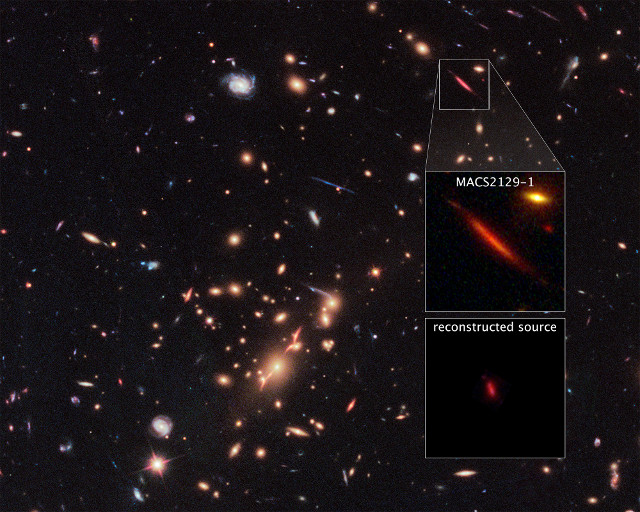
M. Postman (STScI), and the CLASH team)
An article published in the journal “Nature” describes a study of the galaxy MACS 2129-1. An international team of researchers led by Sune Toft of the Niels Bohr Institute (NBI), University of Copenhagen, Denmark used the Hubble Space Telescope and ESO’s Very Large Telescope (VLT) to gather information about MACS 2129-1. The result is that no new stars are being formed and this is really surprising because it’s very far away so we see it as it was at a time when the universe was at the highest rate of star production.
The galaxy MACS 2129-1 is about 10 billion light years away from Earth so we’re seeing it as it was when the universe was little more than 3 billion years old. To obtain enough information for this research, a gravitational lens was used using a galaxy cluster called MACS J2129-0741 which gravity force magnified the image of MACS 2129-1. The image shows the comparison between the galaxy’s full view in the central pane and the view we’d have without the distortions caused by the gravitational lens effect.
This magnification allowed the galaxy MACS 2129-1 to be studied with the Hubble Space Telescope and to gather more information with VLT. The result is that it’s a compact galaxy with an overall mass that is about three times the Milky Way’s contained in a volume that is about half of the Milky Way’s and that spins more than twice as fast as the Milky Way. It’s an elliptical galaxy in which no stars are being formed and is therefore considered dead.
This conclusion came from spectral analyzes of the light coming from the galaxy MACS 2129-1. That light tends to yellow and this indicates a relatively old star population, without the young blue stars typical of a galaxy in which more of them are being born. For example, if we could see the Milky Way from the outside, we’d see it with a partially blue color for the presence of young massive stars that have a limited life, so if no stars are born, after a few hundred million years only the white, yellow and red ones will remain.
This is the first time a galaxy is seen in such a remote era after it finished producing stars. The researchers expected an opposite result because about 10 billion years ago the universe was young and full of hydrogen that could form a lot of new stars at high rates. A galactic merger could cause chaos and interrupt star formation processes but also strongly alter the shape of MACS 2129-1, which is rather regular.
The consequence is that the galaxy MACS 2129-1 is very strange but also very interesting because its study could help scientists better understand the evolution of at least certain types of galaxies. It’s not clear why star formation stopped in MACS 2129-1 and there are only generic hypotheses.
Perhaps at its center there was an active galactic nucleus, where a supermassive black hole surrounded by large amounts of gas and dust emitted huge amounts of energy that blocked star formation. Perhaps cold gas in the galaxy was compressed quickly heating too much to return to temperatures low enough to turn into the type of clouds in which stars are formed.
This is one of the cases in which a study needs follow-up, specifically to understand whether the galaxy MACS 2129-1 is an exception or there are other from that era in the same condition. The huge distance makes the search difficult so the telescopes that will be activated in the coming years will help astronomers.
