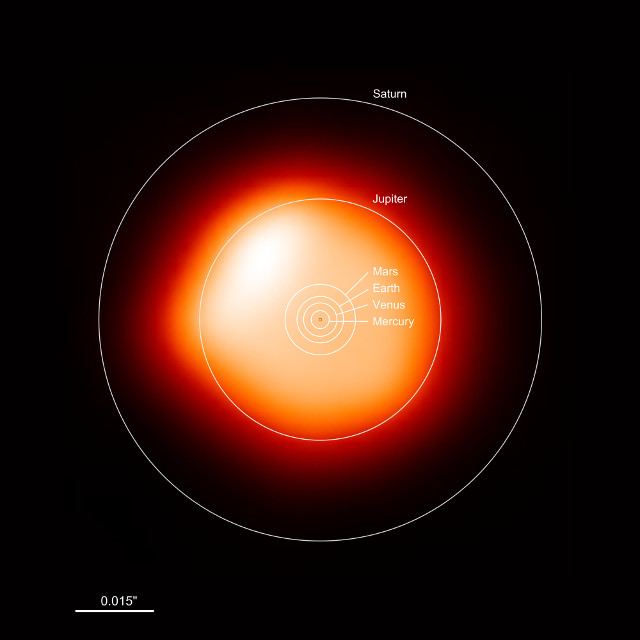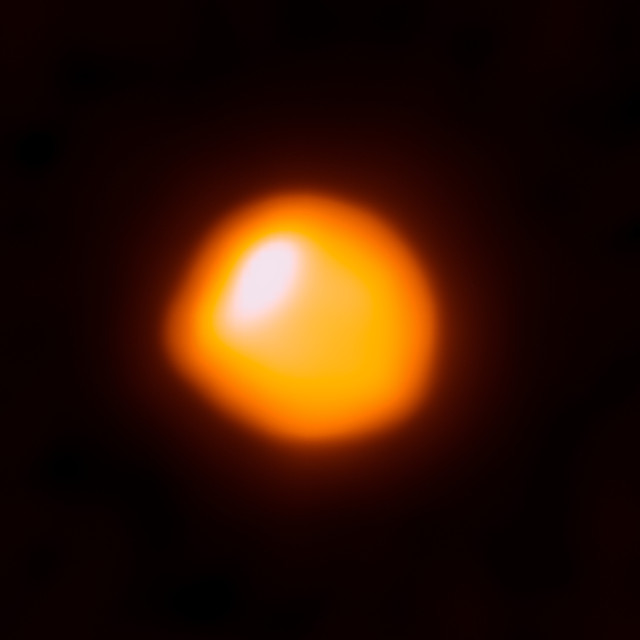
An article published in the journal “Astronomy & Astrophysics” describes a study of the star Betelgeuse conducted using the ALMA radio telescope. This extraordinary instrument studied for the first time the surface of a star to get the highest resolution images ever obtained of Betelgeuse. This made it possible to obtain new data about its atmosphere and its asymmetries that will help to better understand red supergiants in the phases preceding a supernova.
Betelgeuse is the second brightest star in the constellation of Orion after Rigel and makes its left shoulder. It’s a red supergiant whose brightness is variable because it’s in an unstable phase in which its outer layer shrinks and expands. Its size appear to us at the moment about 1,400 times the Sun but because of its state those measurements vary over time.
It’s not possible to say when Betelgeuse will explode into a supernova but astronomers are watching it. This work is helped by its brightness about 100,000 times the Sun’s and its relative proximity since it’s about 600 light years from Earth, not much in astronomical terms. It’s been observed practically with any astronomical instrument that can observe a star.
Over the years, various teams of astronomers have investigated Betelgeuse’s instability discovering a gigantic gas plume almost as wide as the solar system and a bubble that is emitted from the star. At the beginning of 2013, the results of a study carried out using ESA’s Herschel Space Observatory were published that showed a possible collision of the star with a wall of interstellar dust.
This time a team led by astronomer Eamon O’Gorman of the Dublin Institute for Advanced Studies used the ALMA (Atacama Large Millimeter/submillimeter Array) radio telescope, inaugurated in March 2013, to focus on the study of Betelgeuse’s lower chromosphere. In that area of the star’s atmosphere the increase in local temperature explains why it’s not symmetrical.
The atmosphere’s mean temperature is 2.760 Kelvin at 1.3 stellar radii but is very different in asymmetric areas. For example, there’s an area that’s also very elongated that occupies about 5% of the star disk with a temperature that’s about 1,000 Kelvin higher than the mean temperature.
These are just the basic data found thanks to ALMA but their full set gave the researchers clues about what’s happening in Betelgeuse’s atmosphere. These are chaotic phenomena also linked to possible local magnetic fields, another factor in the violent activity not only in its atmosphere but also in core of a star in the most turbulent phase of its life.