
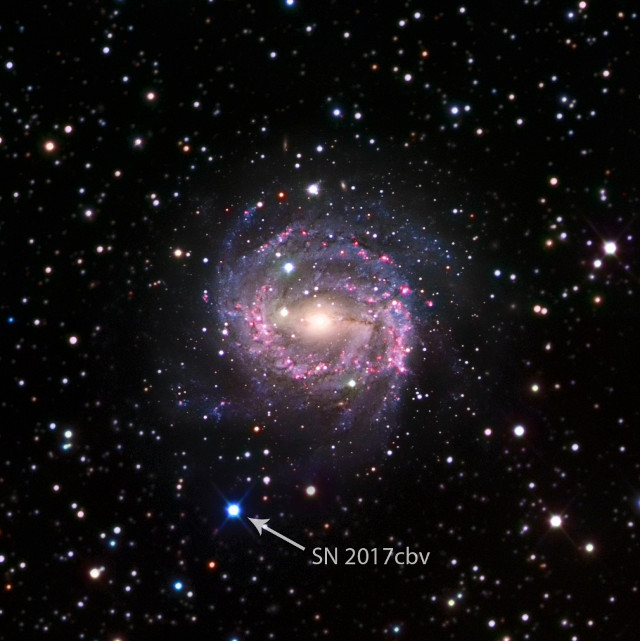
An article published in “Astrophysical Journal Letters” describes the observation of the collision of the supernova SN 2017cbv with a companion. A team of astronomers observed for the first time the details of this type of cosmic event that happened in the NGC 5643 galaxy and was spotted on Earth on March 10, 2017. This is due to the possibility of observing it for five days with the Las Cumbres Observatory (LCO) obtaining data suggesting that the companion was a normal star with a radius about 20 times the Sun’s.
The supernova SN 2017cbv is of type Ia and there have been discussions for decades about the mechanisms that trigger it. The hypotheses were the accumulation of materials around a white dwarf coming from a companion star or the violent merger between two white dwarfs. The only certain factor was the initial presence of a white dwarf but to determine which of the two mechanisms was at its origin they needed to observe the events with great timing to obtain enough data.
The DLT40 (Distance Less Than 40 Megaparsecs) survey keeps about 500 galaxies under observation using the Panchromatic Robotic Optical Monitoring and Polarimetry Telescope (PROMPT) in Chile. Created by two of the authors of this article, David Sand of the University of Arizona And Stefano Valenti of the University of California at Davis, it allowed to discover the supernova SN 2017cbv within a day if not within hours from the arrival of its light to the Earth.
LCO is a network of 18 robotic telescopes scattered around the world so at any time there’s always at least one in an area where it’s night. This allowed the astronomers who discovered the supernova SN 2017cbv to immediately begin monitoring it, a crucial factor in collecting precise, detailed, and continuous data about it. Griffin Hosseinzadeh of the University of California at Santa Barbara explained that it was the key to seeing the blue glow associated with the companion in its rise phase and then its fall.
According to the reconstructions made by the researchers, there was originally a white dwarf and a companion, a massive star with a radius about 20 times the Sun’s. The white dwarf stole gas from its companion and at some point this triggered a supernova. Another interesting fact is that there was a collision between the supernova and the companion that further heated the supernova materials, resulting in the blue glow that also had an ultraviolet component. That kind of shock can’t happen in a collision with another white dwarf.
This research represents a step forward in the study of supernovae for its timing and the details observed. This doesn’t mean that all supernovae of that type happen because of the same mechanism: a research published in April 2016 described the remains of supernova G1.9+0.3, which followed the merger of two white dwarfs. That research was directly linked to the expansion of the universe calculations, one of those supernovae uses as “standard candles” and one of the reasons why that type of research is important.
