November 2017

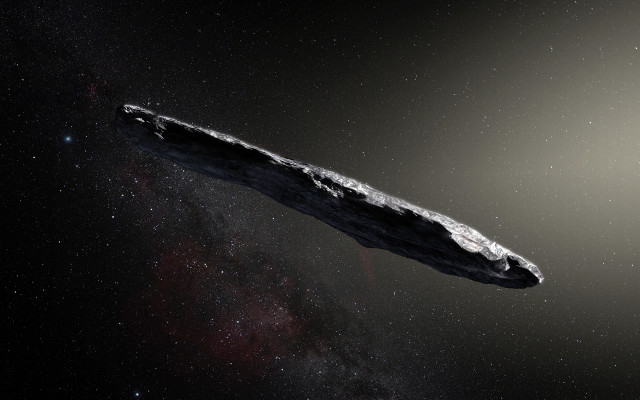
Artist's impression of interstellar asteroid 'Oumuamua (Image ESO/M. Kornmesser)

An article published in the journal “Nature” describes the observations carried out on ‘Oumuamua, the named given to the interstellar asteroid whose discovery was announced only a few weeks ago. It was designated as A/2017 U1 but after the creation of a new class of objects for interstellar asteroids its designation was modified into 1I/2017 U1. Observations with ESO’s VLT (Very Large Telescope) and other telescopes showed that it’s likely dense, rocky, reddish and with a very elongated shape.

Artist's concept of the exoplanet 55 Cancri e and its star (Image NASA/JPL-Caltech)

An article published in the magazine “The Astronomical Journal” describes a research on the exoplanet 55 Cancri e. This super-Earth is one of the most studied among the planets in other solar systems but its extreme characteristics and the often experimental nature of the studies carried out provided partial and sometimes contradictory results. Now a analysis of data gathered using NASA’s Spitzer Space Telescope convinced a team of researchers that 55 Cancri e has an atmosphere and could have a composition similar to that of the Earth.

The JPSS-1 satellite blasting off atop a Delta 2 rocket (Image NASA TV)

A little while ago the JPSS-1 satellite blasted off atop a Delta 2 rocket in its 7920 configuration from the Vandenberg base. After almost one hour it successfully separated from the rocket’s last stage and entered a Sun-synchronous orbit, meaning it will fly over every area of ​​the Earth’s surface at the same local time, at an altitude of about 824 kilometers (512 miles).

Pluto and its atmosphere (Image NASA/JHUAPL/SwRI)

An article published in the journal “Nature” describes a research on the haze present in the atmosphere of the dwarf planet Pluto’s and its effects on its temperatures. According to a team led by Xi Zhang of the University of California at Santa Cruz, the haze absorb the already low heat from sunlight and emits infrared radiation cooling the atmosphere. That’s the explanation for the fact that NASA’s New Horizons space probe measured a temperature even lower than expected.

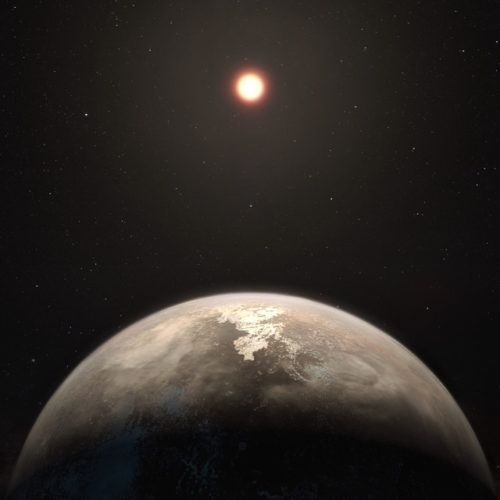
Artist's impressione of the exoplanet Ross 128 b and its star (Image ESO/M. Kornmesser)

An article published in the journal “Astronomy & Astrophysics” describes the discovery of the exoplanet Ross 128 b, which might be similar to Earth with a mass of at least 35% higher than the Earth’s. A team of researchers used the HARPS instrument at the Silla Observatory in Chile to discover this planet about 11 light years from Earth. Its orbit might be in ​its system’s habitable zone making it the second exoplanet closest to the solar system with those characteristics after Proxima b.