2017

Vela supernova remnant at X-rays (Image courtesy ROSAT All-Sky Survey / Federico García et al.)

An article published in the journal “Astronomy & Astrophysics” describes an analysis of the chemical composition of a kind of plasma shrapnel ejected from the Vela supernova remnant. A team led by Federico García of the Argentinian Institute of Radioastronomy used the XMM-Newton Space Telescope to study the plasma jets around the the supernova remnant discovering an abnormal abundance of silicon.

Antares seen by VLTI (Image ESO/K. Ohnaka)

An article published in the journal “Nature” describes the creation of the most detailed image of the surface and atmosphere of a star other than the Sun. A team of astronomers led by Keiichi Ohnaka of the Universidad Católica del Norte in Chile used the Very Large Telescope Interferometer (VLTI) to achieve this result with the red supergiant Antares. It’s also the first map of the materials that make up the atmosphere of a star other than the Sun.

Close-up of the rust on the surface of Rusty Rock (Photo NASA)

An article published in the journal “Proceedings of the National Academy of Sciences” describes a research on the presence of water on the Moon. A team led by the geochemist James M. D. Day of the University of California at San Diego examined amounts and compositions of zinc, chlorine and lead isotopes in a lunar rock concluding that water and other volatile compounds evaporated very early in the Moon’s history. This contradicts a research published only a few weeks ago in which it’s argued that ancient Moon volcanic deposits contain large amounts of water.

Artist's concept of a white dwarf stealing gas from a companion star (Image courtesy Russell Kightley)

An article published in the journal “Science” describes a research on the remnants of a strange supernova cataloged as LP 40-365. According to a team led by Stephane Vennes of the Astronomical Institute of Czech Academy of Sciences in Ondrejov, Czech Republic, that’s a type Iax supernova. It only partially destroyed a white dwarf leaving a part that moves at a very high speed and has an abnormal composition for that dead star type.

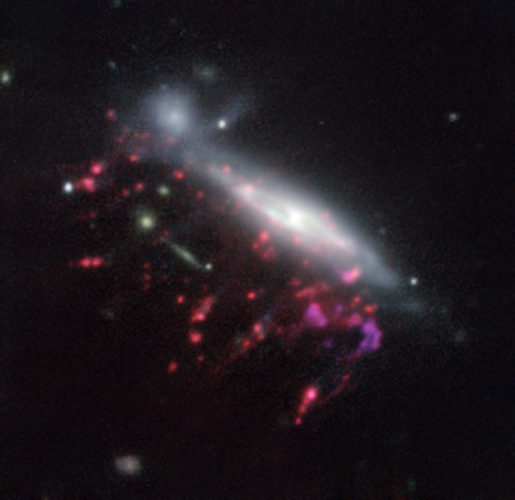
The jellyfish galaxy JO204 (mage ESO/GASP collaboration)

An article published in the journal “Nature” describes a research that shows a new function of the “tentacles” of the so-called jellyfish galaxies. An international team of astronomers led by Bianca Poggianti of the INAF-Astronomical Observatory of Padua in Italy used the observations conducted during ESO’s GASP program with the MUSE instrument installed on the Very Large Telescope (VLT), discovering that the mechanism that generates those tentacles is the same that powers the supermassive black holes at the center of those galaxies.