
2017

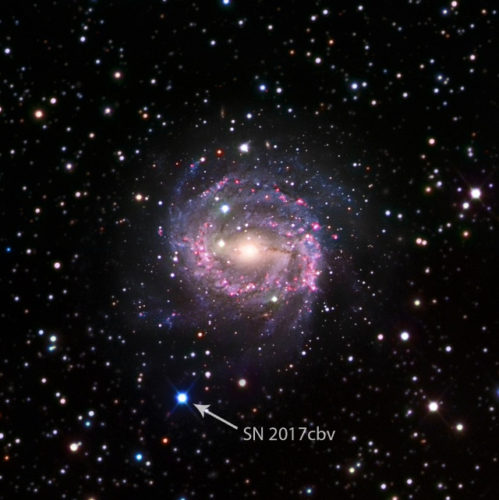
The supernova SN 2017cbv and the galaxy NGC 5643 (Image courtesy B.J. Fulton)

An article published in “Astrophysical Journal Letters” describes the observation of the collision of the supernova SN 2017cbv with a companion. A team of astronomers observed for the first time the details of this type of cosmic event that happened in the NGC 5643 galaxy and was spotted on Earth on March 10, 2017. This is due to the possibility of observing it for five days with the Las Cumbres Observatory (LCO) obtaining data suggesting that the companion was a normal star with a radius about 20 times the Sun’s.

Thaumasia mountains and Coracis Fossae (Image ESA/DLR/FU Berlin, CC BY-SA 3.0 IGO)

ESA has released some photos taken by its Mars Express space probe showing an area of ​​the Thaumasia mountains and Coracis Fossae on Mars. This area is south of the gigantic canyon system called Valles Marineris and of Tharsis volcanoes and shows traces of the activity that led to their formation more than 3.5 billion years ago. The result is a variety of features with mountains and graben.

SpaceX Dragon space cargo ship blasting off atop a Falcon 9 rocket to start its CRS-12 mission (Image courtesy SpaceX)

A little while ago SpaceX Dragon spacecraft blasted off atop a Falcon 9 rocket from Cape Canaveral in its CRS-12 (Cargo Resupply Service 12) mission, also referred to as SPX-12. After just over ten minutes it separated successfully from the rocket’s last stage and went en route. This is the 12th mission for the Dragon spacecraft to resupply the International Space Station with various cargoes and then return to Earth, again with various cargoes.

Artist's concept of the the TRAPPIST-1 system seen from an area near TRAPPIST-1f (Image NASA/JPL-Caltech)

An article to be pulished in “The Astrophysical Journal” describes a research on the age of the TRAPPIST-1 system. This ultra-cool dwarf star has become increasingly popular thanks to the results of research on its planets. One of the problems was to establish its age and astronomer Adam Burgasser of the University of California, San Diego, and Eric Mamajek of NASA’s JPL provided an estimate between 5.4 and 9.8 billion years.