2017

Artist's concept of the dusty starburst galaxy WISE J224607.57-052635.0 (Image NASA/JPL-Caltech)

An article published in “The Astrophysical Journal” describes a research suggesting that in primeval galaxies of the type called dusty starburst – because dust filters their light – star formation activity can be inhibited by the presence of a quasar. A team of astronomers from Iowa University used the ALMA radio telescope to locate the quasars and then other telescopes to observe them at various wavelengths.

Titan and a vinyl cyanide molecule (Image B. Saxton (NRAO/AUI/NSF); NASA)

An article published in the journal “Science Advances” describes the detection of vinyl cyanide molecules on Titan, one of the planet Saturn’s moons. Using archive data of observation carried out with the ALMA radio telescope between February and March 2014, a team of researchers found evidence of the presence of those molecules in significant amounts. The importance of the discovery is due to the fact that it’s a substance considered to be among the best candidate for the formation of membranes and vesicles similar to those of Earth organisms’ cells.

Artist's concept of a gas giant planet with a habitable exomoon (Image courtesy Andy McLatchie)

An article sent to arXiv, the famous archive of preprint, describes the discovery of an exomoon candidate. A team of researchers led by David Kipping of Columbia University conducted a search for moons orbiting exoplanets observed by NASA’s Kepler Space Telescope finding the candidate called Kepler-1625b I. Generally, research results are published on a scientific journal at the end of the work but rumors spread convincing the researchers to send an article at least to arXiv.

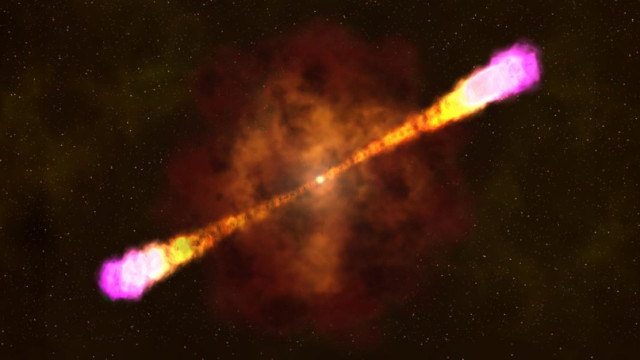
Artist's illustration of a gamma-ray burst (Image NASA’s Goddard Space Flight Center)

An article published in the journal “Nature” describes the observation of a gamma-ray burst named GRB 160625B. An international team of astronomers led by Eleonora Troja of the University of Maryland used a number of telescopes after its discovery with NASA’s Fermi space telescope to detect the properties of this extremely energetic event, its geometry, the orientation of its jets and the origin of its extremely bright optical flash.