2017

Remnant of Supernova 1987A seen by ALMA (Image ALMA (ESO/NAOJ/NRAO); R. Indebetouw; NASA/ESA Hubble)

Two articles, one published in the journal “Monthly Notices of the Royal Astronomical Society” and one in the “Astrophysical Journal Letters”, describe different aspects of a research on the supernova 1987A (SN 1987A). Several researchers used the ALMA radio telescope discovering for the first time a series of molecules in the supernova remnants. This allowed to create a 3D map of what was called a dust factory and to find clues even about star birth.

The galaxy SGAS J111020.0+645950.8 (Image NASA, ESA, and T. Johnson (University of Michigan))

Three articles published in “The Astrophysical Journal Letters” describe various aspects of the observation of the galaxy SGAS J111020.0+645950.8, 11 billion light years away from Earth, with the Hubble Space Telescope. So much attention is due to the fact that the team of astronomers who conducted this study had to use a gravitational lens to conduct the observations and use a very sophisticated analysis to sharpen the images, which also show star formation areas.

The area around the pulsar Geminga (Image Jane Greaves / JCMT / EAO)

An article published in the journal “Monthly Notices of the Royal Astronomical Society” describes a research for possible planets in formation orbiting the pulsar Geminga. The astronomers Jane Greaves and Wayne Holland used the James Clerk Maxwell Telescope (JCMT) in Hawaii to conduct observations at submillimetric wavelengths and understand the mechanisms of planet formation in a system after a supernova.

NGC 5194 and NGC 5195

An article submitted for publication in the journal “Monthly Notices of the Royal Astronomical Society” describes a research on the supermassive black hole at the center of the galaxy NGC 5195, which is undergoing some sort of indigestion. Using data collected with various telescopes, a team of astronomers at the University of Manchester discovered that the black hole causes chaotic events in its galaxy. Among the causes there’s its interaction with a much larger galaxy called NGC 5194 or Whirlpool galaxy.

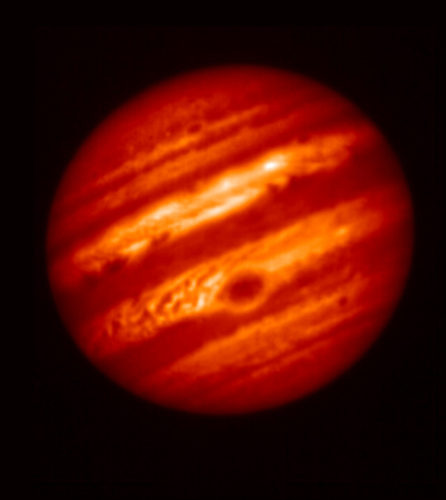
Jupiter seen by the Subaru telescope (Photo NAOJ/NASA/JPL-Caltech)

Two telescopes in Hawaii were used for new observations of the planet Jupiter and in particular of its famous Great Red Spot. They were conducted to support NASA Juno space probe’s mission, which on July 10 will fly over the giant jovian storm. The Gemini North telescope was used with special near-infrared filters to produce specific colors that can penetrate Jupiter’s upper atmosphere and clouds. The Subaru telescope’s COMICS instrument was used with mid-infrared filters.