2017

The Dragon space cargo ship blasting off atop a Falcon 9 rocket (Photo NASA/Bill Ingalls)

A few hours ago SpaceX Dragon spacecraft blasted off atop a Falcon 9 rocket from Cape Canaveral in its CRS-11 (Cargo Resupply Service 11) mission, also referred to as SPX-11. After just over ten minutes it separated successfully from the rocket’s last stage and went en route. This is the 11th mission for the Dragon spacecraft to resupply the International Space Station with various cargoes and then return to Earth, again with various cargoes.

Halos in Martian silica (Image NASA/JPL-Caltech)

An article published in the journal “Geophysical Research Letters” describes a research on silica halos discovered in the lower areas of the northern slopes of Aeolis Mons in the Gale Crater on Mars. A team of researchers led by Jens Frydenvang used the information gathered by NASA’s Mars Rover Curiosity to try to figure out for how long there was liquid water, concluding that the needed conditions lasted longer than expected.

Jupiter's South Pole (Image NASA/JPL-Caltech/SwRI/MSSS/Betsy Asher Hall/Gervasio Robles)

Two articles published in the journal “Science” and a special issue of the journal “Geophysical Research Letters” describe various researches about the planet Jupiter based on data collected by NASA’s Juno space probe. Many scientists participated in one or more of those researches, each focusing on a phenomenon in progress on Jupiter and in the area of ​​influence of its magnetic field, with several news that sometimes are surprising.

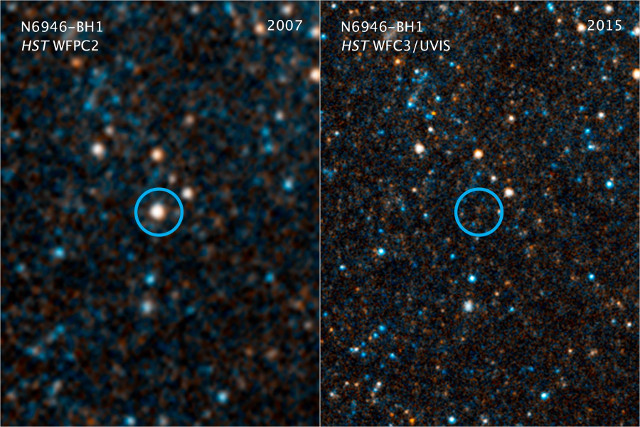
The area where the star N6946-BH1 used to be before and after its disappearance (Image NASA/ESA/C. Kochanek (OSU))

An article published in the journal “Monthly Notices of the Royal Astronomical Society” describes the discovery of a massive star called N6946-BH1 that collapsed and seems to have formed a black hole directly without exploding into a supernova. A team of astronomers led by Christopher Kochanek used the Large Binocular Telescope (LBT) in Arizona and NASA’s Hubble and Spitzer space telescopes to observe for the first time this phenomenon, which could explain why there are less supernovae than expected.