2017

Scheme of the molecular oxygen production process (Image courtesy Caltech)

An article published in the journal “Nature Communications” provides an explanation for the presence of oxygen molecules on the comet 67P/Churyumov-Gerasimenko. Konstantinos Giapis, a chemical engineer at Caltech, conducted this research after noting that the chemical reactions that took place on the comet’s surface were similar to those he had been generating for years. The most likely hypothesis initially offered was that it had “survived” since the solar system’s formation but perhaps the correct explanation has now been found.

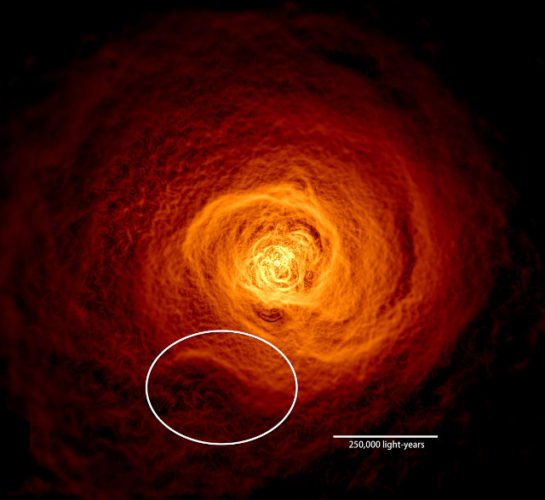
X-ray image of the hot gas in the Perseus galaxy cluster (Image NASA's Goddard Space Flight Center/Stephen Walker et al.)

An article published in the journal “Monthly Notices of the Royal Astronomical Society” describes the discovery of a large wave of hot gas in the Perseus galaxy cluster that extends for about 200,000 light years. A team of astronomers led by Dr. Stephen Walker of NASA’s Goddard Space Flight Center combined observations with NASA’s Chandra X-ray Observatory and others at radio frequencies with computer simulations to study it.

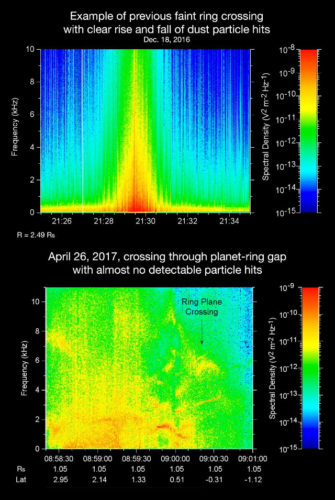
Some data from the RPWS instrument (Image NASA/JPL-Caltech/University of Iowa)

The first results of the analysis of the data collected by the Cassini space probe during its dive into the space between the planet Saturn and its rings on April 26, 2017 provided a remarkable surprise. The researchers discovered that Cassini’s instruments recorded very few particles during the crossing of that space and all of them were tiny, around a micron across. This is a mystery to which the researchers hope to find an explanation.

The galaxy NGC 5917 (Image ESA/Hubble & NASA)

An image captured by the Hubble Space Telescope of the galaxy NGC 5917 just published shows it on its own. This could be considered normal but this is a special case because it’s a galaxy known mainly for its interaction with a neighbor known as MCG-01-39-003. Those are interacting galaxies, an expression used when there are galaxies that affect each other with their mutual gravity. NGC 5917 and MCG-01-39-003 could end up merging.